
SEO for LLMs: How to Build Brand Visibility in Generative Engines
By Jon Earnshaw|01 Sep 2026|5 min read
Search no longer stops at a results page.
People are asking questions in ChatGPT, Google AI Mode, Gemini, Claude and Perplexity. They compare options, introduce new requirements and refine decisions through follow-up questions. Each answer shapes where the conversation goes next.
For brands, that creates a different visibility challenge. Ranking for a keyword or appearing for one carefully chosen prompt does not tell you enough. You need to know whether your brand stays in the conversation, how it is represented, which sources influence the answer and where a competitor takes over.
That is where SEO for large language models, or SEO for LLMs, begins.
SEO for LLMs is not a new bag of tricks for manipulating AI answers. It extends search strategy into a new layer. Discoverability, useful content, technical accessibility, authority and trust still matter. What changes is how information is found, interpreted, checked and recommended.
The question is no longer only:
Where do we rank?
It is also:
Are we present throughout the conversations shaping decisions in our market?
What is SEO for LLMs?
SEO for LLMs is the work of making a brand and its content easier for AI systems to find, understand, cite and recommend accurately across ChatGPT, Google AI Mode, Gemini, Claude and Perplexity.
You may also see it called answer engine optimization (AEO), generative engine optimization (GEO), AI search optimization or LLM optimization. Do not get stuck on the label. The job is to publish useful, reliable information that search engines and AI systems can find, understand and check against other sources.
Traditional SEO is the foundation of that work. If search engines cannot crawl, render, index and understand your content, you have weakened its chance of being discovered elsewhere too. Clear site architecture, strong internal linking, relevant content, recognized entities, authority and trust do not become less important in AI search. They become the base on which AI visibility is built.
That is why I do not see SEO for LLMs as a replacement discipline. First, get the SEO basics right. Make the site technically sound, make the information easy to find and make the content genuinely useful. Then add the conversational layer: map how questions develop, see whether the brand remains present, identify the sources influencing the answer and create the citation doorways needed to close the gaps.
Search engines, websites, publishers, knowledge sources, reviews, videos and social platforms all contribute to the information environment AI systems can use. Strong organic visibility can support AI visibility, but the two are not identical.
A page can rank in traditional search without becoming an influential citation doorway. A third-party source can shape an AI answer even when it is not part of your owned website. A brand can be mentioned during discovery but disappear when the conversation reaches comparison or recommendation.
The goal is not simply to collect more mentions. It is to be represented accurately, supported by trusted evidence and present when the conversation reaches the decision.
The core differences between traditional SEO and SEO for LLMs, and why the old rules aren’t enough anymore
This is not about discarding everything we know but about recognising that the game has changed. Think of it as an expansion of traditional SEO. The foundations remain relevant, but we need to broaden our approach.
LLMs interpret content through a different lens than traditional search crawlers. They do not just scan pages for keywords; they ingest information, break it into tokens, and evaluate the semantic relationships between words, concepts, and context. It is no longer just about creating a perfect snippet but about how the AI understands and represents our brand.
LLMs pull from the entire digital footprint. Social media, PR, industry mentions—all of it contributes to the authority ecosystem. It is not enough to focus on keyword density or backlinks. The task is to build a consistent, accurate, and authoritative presence that models can recognise and reward.
Key differences include:
- Primary goal: From ranking and click-throughs to influencing how LLMs interpret, synthesise, and present brand information in direct answers.
- Content presentation: From optimising for snippets to ensuring our content is accurately summarised or synthesised, often without direct citations.
- Keywords vs. concepts: Moving from specific keywords to broader themes, semantic relevance, and entity-based optimisation.
- Scope of optimisation: From focusing on one website to optimising the entire digital footprint—social media, PR, third-party platforms, and authoritative databases.
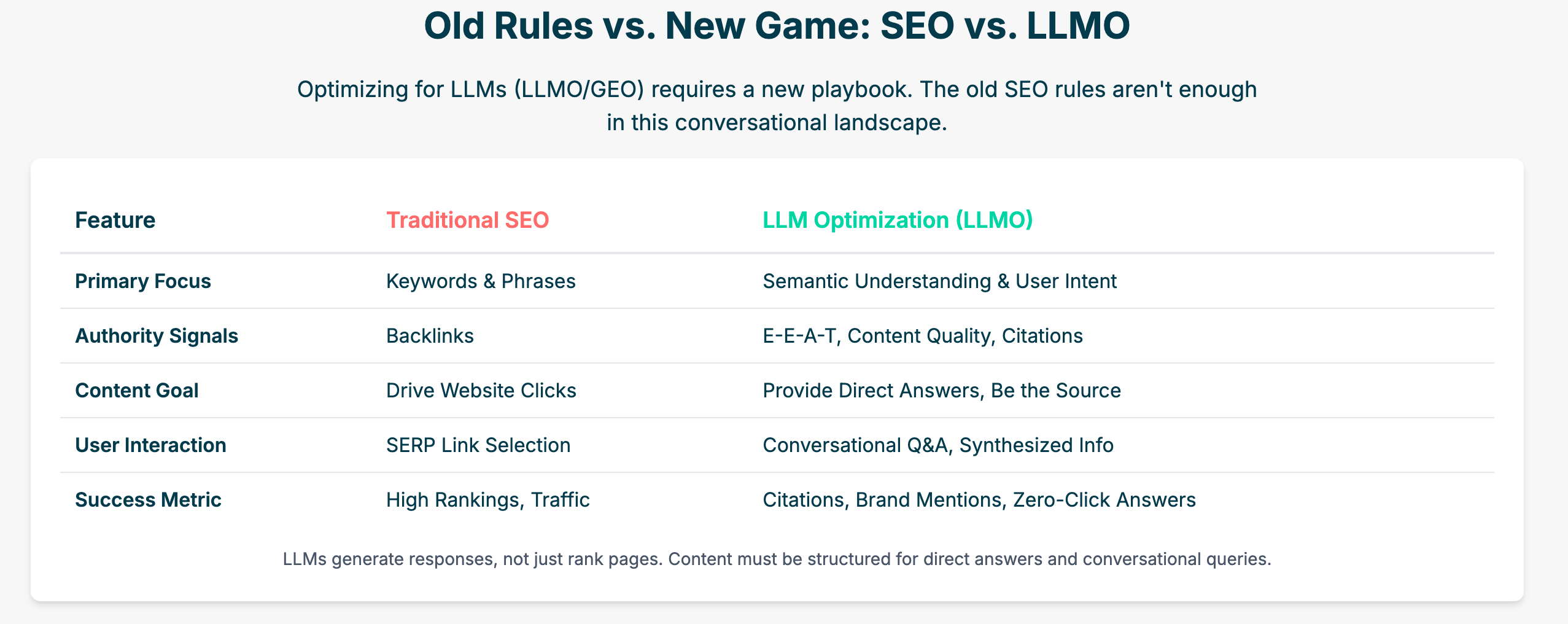
Traditional SEO vs. LLM Optimisation: Understanding the new rules of engagement in the evolving search landscape
Each model (ChatGPT, Perplexity, Gemini, Claude) has its nuances. Some lean heavily on sources like Wikipedia and Reddit; others prioritise news outlets and real-time data. Covering all bases with high-quality, consistent content is essential.
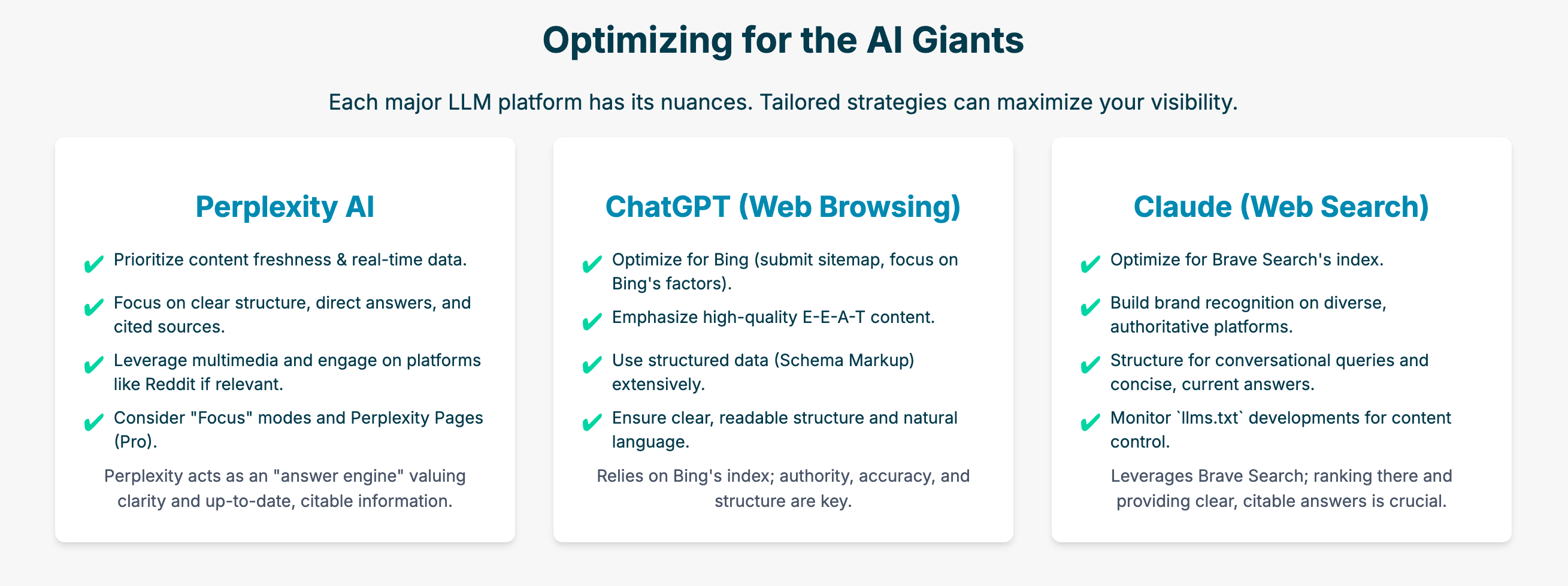
Understanding the unique behaviours of ChatGPT, Perplexity, Gemini and Claude is essential
Keywords, prompts and conversations
For years, search strategy was organized around keywords. As conversational interfaces emerged, the natural response was to replace keyword lists with prompt lists.
That is a logical starting point, but it carries over the same limitation. A prompt is still an isolated input. Real journeys develop through context and follow-up questions.
Someone researching an electric vehicle might begin with a broad question, compare models, introduce a budget, ask about charging, consider family requirements, raise concerns about range and finally request a recommendation. A brand can appear during discovery and disappear during comparison. Another may enter only when the user introduces a specific constraint.
At Pi, we call the connected set of questions, follow-ups, topics and decisions a conversation space. Mapping that space helps reveal:
- The questions that begin the journey
- The follow-ups that develop it
- The topics and objections that change the answer
- The points at which brands enter or leave the conversation
- The competitors and sources influencing recommendations
- The stages where stronger information is needed
There is nothing wrong with tracking prompts or optimizing for them tactically. But prompt tracking is useful, not sufficient. The strategy is to follow the conversation and understand where your presence becomes weak.
For a detailed explanation, read my article on ‘what prompts should I track?’
Is LLM SEO the same as AEO or GEO?
SEO for LLMs, AEO and GEO overlap considerably. All concern how information becomes discoverable, understandable and usable within AI-generated answers
.
The terminology matters less than the work: accessible information, clear entities, original evidence, authority beyond your own website and measurement across the conversations that matter.
Practical strategies to build authority, get cited by LLMs and optimize your content for AI-driven discovery
No single change guarantees a mention or citation. The work is to improve the quality, accessibility and corroboration of the information available to search engines and AI systems.
Ensure important information is accessible
AI experiences cannot use information they cannot discover or retrieve. Important brand, product and service information should be available in accessible page content rather than hidden behind unnecessary login walls, blocked resources or interfaces that make the underlying information difficult to access.
Start with the same technical checks an experienced SEO team should already be making: crawlability, indexability, rendering, canonicals, internal linking and a clear site structure. Make sure important pages can be discovered and that their purpose is unambiguous.
Be cautious about claims that allowing one particular AI crawler will automatically create visibility. Different platforms use different retrieval and data sources. Technical accessibility does not guarantee a citation, but without solid foundations you are making every later stage harder.
Make your entities and expertise clear
AI systems need to understand the relationships between your organization, people, products, services, audiences, use cases and areas of expertise.
Do not assume those relationships will be inferred correctly. Explain what products do, who they are for, how they differ, which problems they solve and what evidence supports the claims. Connect authors and experts to the subjects they genuinely understand. Keep important facts consistent across owned and third-party sources.
Make E-E-A-T visible
Quality and authority are non-negotiable. E-E-A-T: experience, expertise, authoritativeness and trust should be visible in the content itself, not treated as a checklist added after publication.
Show who created the content and why they are qualified to do so. Include firsthand experience, original evidence, transparent sourcing and accurate information. Keep author, organization and product details consistent. Review important content regularly so that outdated claims do not weaken trust or create conflicting versions of the truth.
E-E-A-T remains part of the SEO foundation. FAST and DUO help us apply those principles to the content we want people and AI systems to trust and cite. They are connected ideas, not competing frameworks.
Create information worth citing
Generic information is easy to summarize and replace. If you want to be cited, give the system something worth citing: depth, evidence, experience or a point of view it cannot find everywhere else.
At Pi, we use three connected frameworks to assess those signals:
- The Interpretation Stack considers Inputs, Novelty, Threads, Entities and Reputation.
- FAST content is Firsthand, Authentic, Social and Trusted.
- DUO content is Deep, Unique and Original.
DUO makes content worth citing. FAST makes it human enough to trust. The Interpretation Stack shows how that content connects with the brand and the wider ecosystem.
These frameworks support the optimization stage, but they are not the measurement system itself. Read our full guide to creating content that performs across traditional search, AI search and AI assistants for the complete methodology.
Build a connected content ecosystem
A conversation rarely begins and ends on one page. Someone may read an introductory guide, watch a video, compare approaches, review evidence, explore a product page and consult independent sources before reaching a decision.
Articles, webinars, videos, research, case studies, product information and relevant third-party coverage should reinforce the same expertise and terminology. Connecting these assets gives people and AI experiences several useful routes into the brand’s knowledge.
Strengthen authority beyond your website
Your website should be the clearest source of truth about your brand, but AI-generated answers can be influenced by publishers, reviews, industry sites, communities, creators and other third-party sources.
This does not mean forcing the brand into Wikipedia, Reddit or every available directory. Find the sources that genuinely influence your market’s conversations, then check whether the information they carry is accurate, useful and current.
Structure information clearly
Clear headings, concise answers, lists, tables and natural question-and-answer formats can make information easier to navigate, interpret and retrieve. They can also help readers understand complex subjects more quickly.
Use relevant structured data to make entities, relationships and page purpose more explicit where the markup accurately reflects the visible content. Schema is not a shortcut to AI visibility, but it can strengthen the machine-readable foundation alongside semantic HTML, logical hierarchy and clear internal linking.
Formatting is not authority. A perfectly structured page that repeats generic advice still gives an AI system no reason to choose it.
How Pi built presence across the complete conversation
We tested this approach against a question I am asked almost every day: When measuring performance across AI surfaces, is it better to track prompts or conversations?
We knew this was a real audience problem because it came up repeatedly in client meetings, workshops and webinars. We researched the question, gathered the data and built a connected content ecosystem that answered it directly while anticipating where the conversation could go next.
In Google AI Mode, the journey developed across four turns.
Turn one: prompts or conversations? Pi earned six citation doorways, including video and supporting content. The answer drew on the evidence we had created around why individual prompts cannot represent a multi-turn journey.
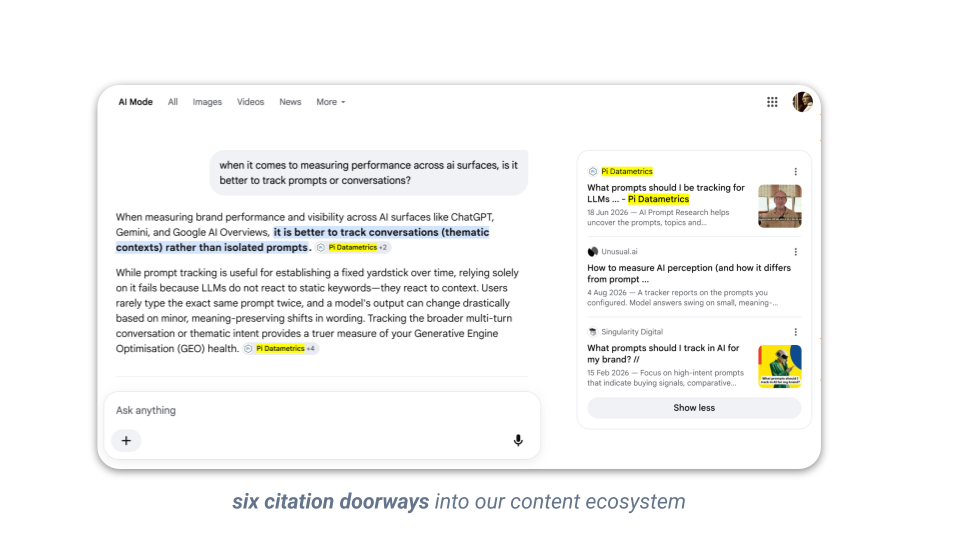
Turn two: which software can measure the conversation layer? Pi was recommended for analyzing and visualizing brand performance at the conversation level. A different video from the ecosystem appeared as a citation, supporting a more product-focused follow-up.
Turn three: can you identify the exact prompts people use? Pi remained in the conversation. Our overall citation presence reduced, but a prominent doorway still connected the answer to our content.
Turn four: which provider would you choose? At the decision stage, Google AI Mode recommended Pi and explained why it met the stated requirements. This is the turn that matters most. If the brand disappears before the recommendation, strong presence at the opening question has not done its job.
We did not attempt to optimize one page for four isolated prompts. The article, research, videos, images and supporting content worked together across the journey. Different assets opened different doorways, and language from my videos also contributed to the synthesized answers.
That is the real lesson from the example. Six citations at the first turn were useful, but remaining present as the user refined the problem, evaluated the product category and asked for one recommendation was the stronger result.
How to audit your brand’s current presence for conversational search – and close visibility gaps
You cannot improve conversational visibility through assumptions or the occasional manual check. Start with a stable set of relevant journeys, measure brand presence and find out why another brand or source is being selected instead.
The original version of this article focused on manual AI Overview checks and early LLM tracking. At Pi Datametrics, we can now map complete conversation spaces and analyze brands, mentions, citations, sentiment and source influence across AI search.
1. Map the conversations that matter
Start with a commercially or strategically important audience problem, then build the conversation around it in Pi. Use search demand, customer questions, sales conversations, community discussions and the follow-ups people ask within AI search to identify the directions the journey could take.
Pi’s Conversation Mapping gives the team a defined conversation set to analyze. We are not trying to predict one perfectly worded prompt. We are mapping the likely directions in which the audience’s thinking could develop, including the deeper questions competitors may already answer better.
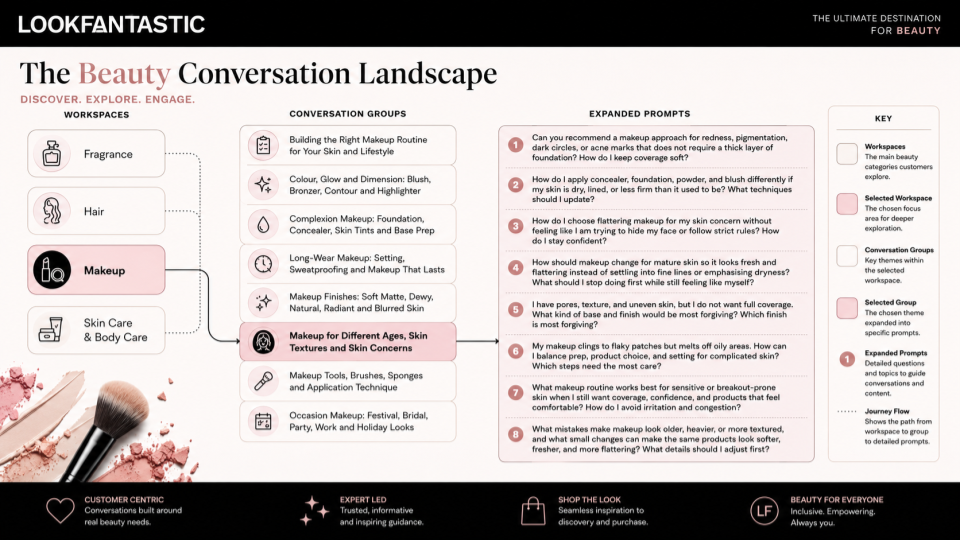
2. Measure your current Conversation Presence
Once the conversation set is in Pi, visualize performance across the complete journey rather than checking prompts individually.
Compare your brand with competitors and examine the signals that make up Conversation Presence:
- Brand presence: does the brand appear within the conversation space?
- Mention frequency: how often is the brand discussed?
- Citation frequency: how often is a domain or page cited?
- Citation share: how much of the cited-source landscape does the brand or domain occupy?
- Sentiment: is the brand framed positively, neutrally or negatively?
- Factual accuracy: is the information presented about the brand correct?
- Source influence: which domains and pages are shaping the answer?
- Competitive presence: which alternatives appear and where do they replace the brand?
- Journey-stage presence: does the brand remain visible from discovery through comparison and recommendation?
Pi brings these signals into one view across the selected conversation set and AI platforms. Teams can compare all brands, select their own brand or drill into a competitor to understand how presence, mentions, sentiment and citations differ.
The Conversation Presence Index (CPI) summarizes how visible, influential and recommendable a brand is across the conversations that matter to the business. Use the index as the starting point, then investigate the underlying conversations, turns and sources behind the score.
3. Find where your brand leaves the conversation
Plot brand presence across the mapped conversation in Pi:
Do not stop at, “Are we visible?” Use the conversation view to find the exact turn where your presence weakens, citations reduce or a competitor takes over.
If the conversation moves into pricing, validation, implementation, risk or a specific use case, does the brand remain present? Pi helps show which competitors enter at that point, whether their presence is owned or earned and which sources supply the evidence behind the answer. That exit point defines the opportunity.
4. Examine the citation doorways replacing you
In Pi, mentions and citations are analyzed separately. Mentions show which brands AI talks about. Citations show which pages and domains the experience has chosen to support its answer.
A citation doorway is a page or domain through which reliable information enters an AI-generated conversation. It may be an owned guide, product page, publisher article, review, community discussion, video or another trusted source.
5. Strengthen and connect the ecosystem
This is where FAST, DUO and the Interpretation Stack become operational. Use them to assess the candidate content identified through Pi and decide what it needs in order to become more useful, trustworthy and citable. Then connect it to the wider content ecosystem rather than treating it as an isolated page.
6. Validate the result
Keep the same representative conversation set in Pi and measure it again. Look for changes in Conversation Presence, owned and earned mentions, citations, source influence, sentiment and competitor position.
Use the conversation view to see whether new doorways have opened and whether the brand now remains present beyond the point where it previously dropped out. Treat movement as evidence to investigate, not instant proof of causation. The test is whether the brand is present for more of the journey, contributes more of the evidence and reaches the final comparison or recommendation.
Account for differences between AI platforms
Visibility varies across ChatGPT, Google AI Mode, Gemini, Claude and Perplexity. Each can use and present sources differently, and all of them change over time.
You do not need a separate content strategy for every platform. You do need measurement that spots meaningful differences without turning one temporary observation into a universal rule.
Compare whether the same brands appear, whether different domains are cited, how the brand is framed and where competitors enter across the platforms that matter to the audience.
Watch: How to win more AI citations and measure Conversation Presence
In this webinar, I explain how to map the conversations shaping your market, identify where your brand leaves the journey and create stronger citation doorways using FAST and DUO content. You will also see how Ricoh Europe used this approach to improve presence across connected AI conversations.
What SEO teams should do next
Do not begin by generating hundreds of prompts or rewriting every page for an AI assistant. Start with one conversation that influences a meaningful decision.
Choose one commercially important conversation space. Map how it develops. Measure where your brand and competitors appear. Identify the sources AI systems use. Then diagnose the content, entity, citation or reputation gap behind the result.
Traditional search is not the old layer we leave behind. It is the foundation. Technical accessibility, site structure, useful content, authority and trust still determine whether your information can be found and understood.
What has changed is the unit of strategy and measurement. It now extends beyond the individual keyword and page to the complete conversation and the information ecosystem behind it. Get the foundations right, then measure where the brand enters the conversation, where it leaves and which sources take its place.
The question for every brand is straightforward: where do you enter the conversation, where do you leave it, what replaces you and what will you do about it?
Understand where your brand appears across AI conversations
Pi Datametrics helps enterprise teams map the conversations shaping their markets, measure Conversation Presence and investigate the brands, citations, sentiment and sources influencing AI-generated answers.
Explore Pi’s AI Search Visibility Tool or book a demo to see where your brand is present, where competitors are gaining ground and which citation doorways offer the next opportunity.
Ready to turn conversational AI into a competitive edge?
Request a demo



Never miss a post
Join our mailing list and have our SEO news delivered straight to your inbox.