AI Brand Monitoring and Sentiment Tool
See how AI search represents every brand in your market
Track which brands appear across AI-generated answers, how often they are mentioned and whether the surrounding sentiment is positive, neutral or negative.
Compare your brand presence against competitors, then investigate the queries, citations and sources shaping how AI search represents each brand throughout the conversation.
AI Brand Monitoring
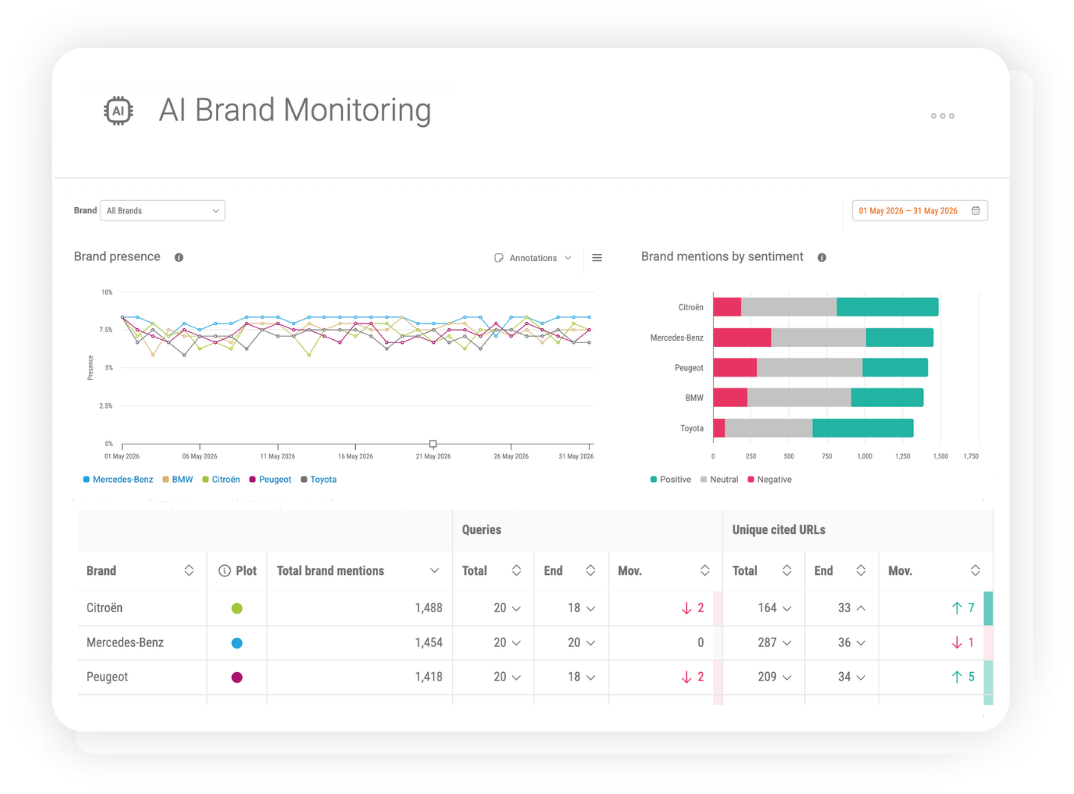
Compare every brand appearing across AI search
Understand which brands are present across the conversations shaping your market and how their visibility changes over time.
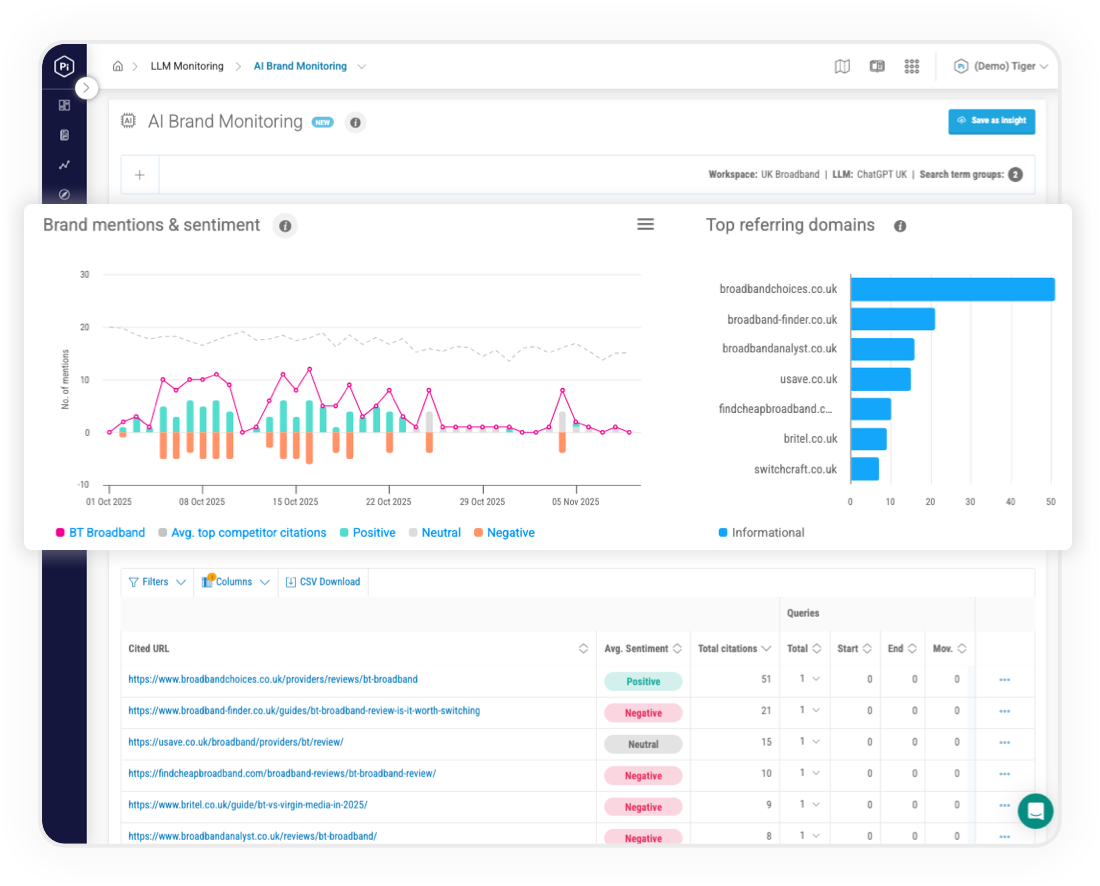
Pi brings brand presence, mentions, sentiment, queries and cited sources together in one view. Compare your brand with established competitors, category leaders and emerging names to see who is gaining attention and where your own presence could be stronger.
- Compare brand presence and total mentions
- See positive, neutral and negative sentiment by brand
- Measure changes across selected dates
- Compare the queries and unique cited URLs associated with each brand
- Identify brands gaining or losing presence within the market
AI Brand Analysis
Drill into your brand or any competitor
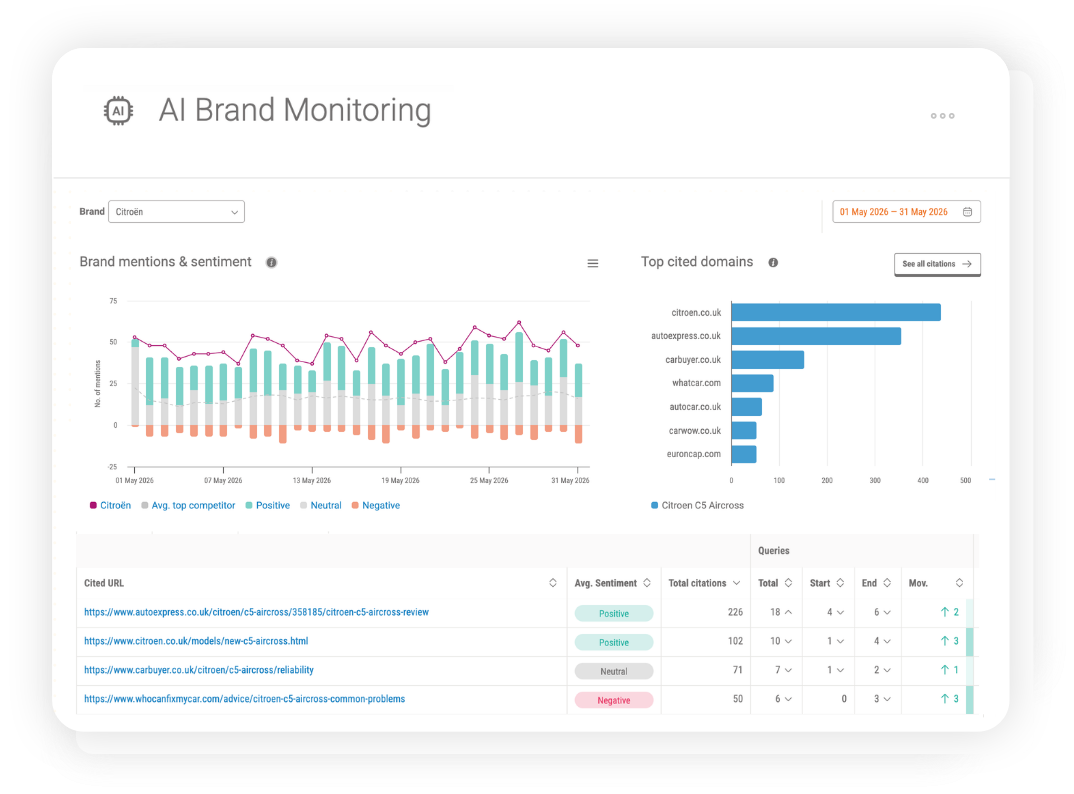
Select any brand appearing within your conversation space to investigate its performance in greater detail.
Explore your own brand to understand where and how it is represented, or select a competitor to uncover the queries, sentiment and sources supporting its presence. This helps you move from a market-wide comparison to the specific signals driving each brand’s performance.
- Track mentions and sentiment for any selected brand
- Compare performance against leading competitors
- See which queries and conversation groups mention the brand
- Identify the domains and URLs most frequently cited
- Investigate where competitors are building stronger visibility
AI Brand Sentiment
Understand the tone and context behind every mention
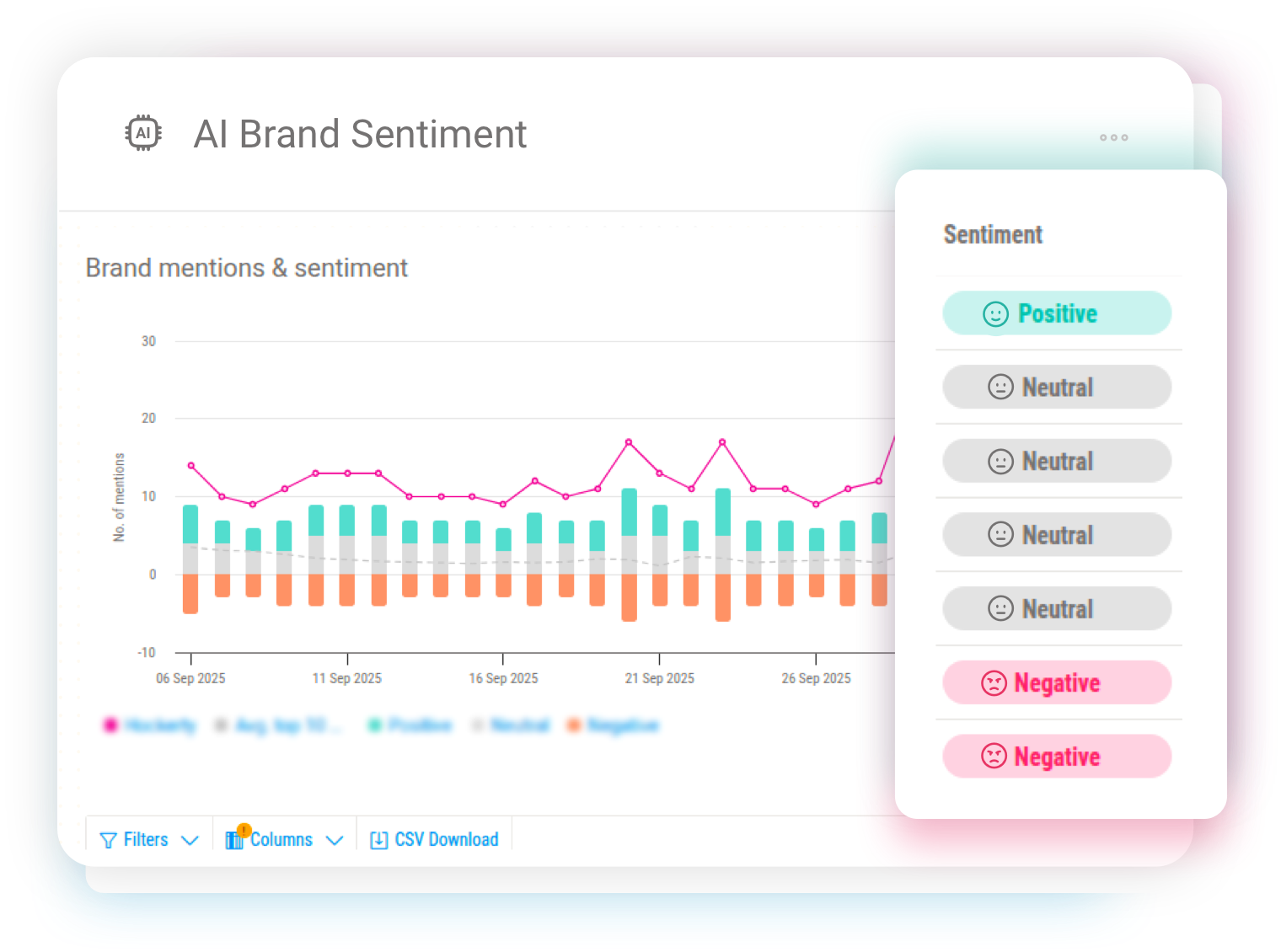
A mention alone does not tell you how an AI system represents a brand.
Pi analyzes the context surrounding each brand mention and classifies its sentiment as positive, neutral or negative. Compare how your brand and competitors are described, monitor changes over time and identify the queries connected with different brand narratives.
- Analyze positive, neutral and negative sentiment
- Compare sentiment across your brand and competitors
- Track changes in brand perception over time
- Identify queries associated with positive or negative references
- Spot potentially outdated, misleading or high-impact narratives
Brand Citation and Source Intelligence
See which sources are shaping brand perception
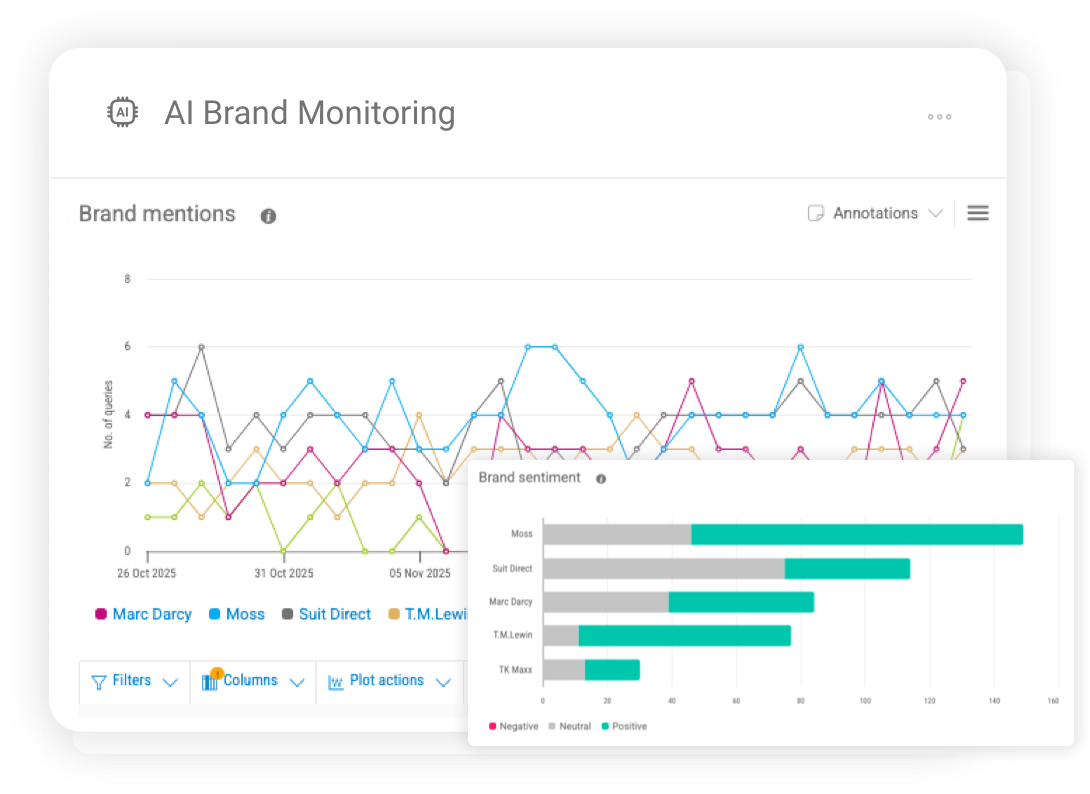
Understand why AI search describes a brand in a particular way by connecting its mentions and sentiment with the sources cited in the response.
Pi shows the domains and individual URLs influencing your brand and competitors. Review the sentiment, citations and queries associated with each source to understand who is shaping the conversation and where action could strengthen your position.
- Identify the most frequently cited domains
- Review the URLs associated with your brand or a competitor
- Compare average sentiment by cited source
- See the queries connected with each citation
- Find the sources influencing changing or negative narratives
Turn AI search intelligence into action
Work with Pi’s experts to strengthen your visibility across AI search, or connect your AI assistant directly to Pi’s search intelligence through MCP.
More information around brand monitoring & sentiment
An AI brand monitoring tool tracks how brands appear within AI-generated answers across LLMs and AI search experiences such as ChatGPT, Claude and Google AI Mode.
It shows how frequently a brand is mentioned, whether the surrounding sentiment is positive, neutral or negative and which sources influence how the brand is represented.
Pi Datametrics lets teams compare every brand within a market or select an individual brand to investigate its mentions, sentiment, queries, citations and changes over time.
Pi Datametrics analyzes the sentiment surrounding brand mentions across supported LLMs and AI search experiences, including ChatGPT, Claude and Google AI Mode.
Mentions are classified as positive, neutral or negative according to the context in which the brand appears. Organizations can monitor UK and international conversation datasets, compare sentiment against competitors and investigate the queries and cited sources influencing each brand narrative.
This helps teams understand not only whether AI mentions their brand, but how it describes and positions it throughout the conversation.
Pi analyzes the language and context surrounding each brand mention and classifies its sentiment as positive, neutral or negative.
Users can view sentiment across every brand in a selected workspace or choose an individual brand for deeper analysis. This can be their own brand, a direct competitor or any other brand appearing within the conversation space.
The individual brand view connects sentiment with cited URLs, query coverage and the domains most frequently influencing how the brand is represented.
Yes. Pi compares brand presence, mention volume and sentiment across brands appearing within the same conversation spaces.
The All Brands view shows which brands are most present, how their mentions divide between positive, neutral and negative sentiment and how performance changes over time.
You can then select your own brand or drill into any competitor to compare mentions, queries, unique cited URLs and source influence in greater detail.
Yes. Pi connects brand mentions and sentiment with the URLs cited in relevant AI-generated answers.
For any selected brand, you can see its top cited domains and review individual cited URLs, including their average sentiment, total citations and associated queries.
This helps identify the publishers, review sites, communities and owned pages influencing how AI search describes your brand and its competitors.
Brand presence measures the proportion of relevant queries in which a brand appears.
Brand mentions count references to the brand within AI-generated answers.
Citations identify the sources referenced within those answers.
Sentiment describes whether the language surrounding a brand mention is positive, neutral or negative.
Together, these signals provide a more complete understanding of AI brand visibility. A brand may be mentioned frequently but supported by relatively few citations, or have strong presence while being represented less positively than its competitors.
People rarely make decisions through one isolated question. They ask follow-up questions, compare alternatives and request recommendations as the conversation develops.
A brand may appear during initial research but disappear when the conversation moves closer to a decision. Its sentiment may also change depending on the subject, comparison or source influencing the answer.
Pi organizes related prompts into conversation spaces, helping teams understand where brands appear, how they are represented and which sources influence their presence across different stages of discovery.
Pi allows users to select a date range and compare brand mentions, sentiment, queries and unique cited URLs between the beginning and end of the period.
Movement metrics show whether a brand is appearing across more or fewer queries and whether its supporting citation landscape is changing.
Teams can use this to identify developing shifts in brand perception and investigate the underlying answers, queries and sources connected with the change.
Pi helps teams investigate potentially inaccurate, outdated or misleading brand narratives by showing the surrounding context, associated queries and cited URLs influencing an AI-generated response.
It does not automatically correct the information. Instead, it provides the evidence needed to understand where the narrative may have originated, determine which sources require attention and monitor whether the brand’s representation changes after action is taken.
Start by identifying the queries where negative sentiment appears and reviewing the context in which the brand is discussed.
You can then examine the cited sources influencing those answers to determine whether the narrative is connected with outdated information, recurring criticism, third-party reviews or gaps in authoritative brand content.
Pi supports this investigation by connecting negative mentions with their queries and sources. SEO, content, brand and PR teams can then determine the appropriate response and monitor subsequent changes.
Yes. Pi enables teams to monitor and compare brand representation across supported AI search experiences, including ChatGPT, Claude and Google AI Mode.
Because platforms can generate different answers and draw on different sources, a brand may have strong presence or positive sentiment in one environment but perform differently in another. Pi helps teams investigate these differences across selected markets and conversation spaces.
Pi brings brand presence, mentions, sentiment, competitors and cited sources together within one connected view.
Teams can compare every brand in a market, investigate their own brand or any competitor and trace different narratives back to the queries and sources influencing them.
AI Brand Monitoring is part of Pi’s connected AI Search Visibility platform, allowing teams to combine brand intelligence with wider citation, site, conversation and traditional search performance data.
See how AI search represents your brand
Compare your brand presence, mentions and sentiment across ChatGPT, Claude, Google AI Mode and other supported AI search experiences. Investigate the competitors, queries and cited sources shaping how your brand appears throughout the conversation.