What is a Google AI Overview? How it works, how to track it and how to get cited
By Emily Walton|30 Apr 2025|5 min read
A Google AI Overview is an AI-generated summary that can appear at the top of Google's search results. It pulls together information from several sources to help someone understand a question quickly, with links to the pages it used.
AI Overviews are now a normal part of searching. Google says they have over 2.5 billion monthly active users (Google). For brands, that raises a new question. It's no longer just "do we rank?" but "are we part of the answer?"
In this guide, we explain what AI Overviews are, how they connect to AI Mode, what zero-click results mean for your business, and how to track AI Overviews and get cited in them.
What is a Google AI Overview?
As the video above explains, an AI Overview pulls together information from different sources to give a result that helps the searcher understand a question quickly.
Pi's SEO glossary defines it as "an initial, AI-generated answer made up of synthesized content that appears at the top of Google's standard search result links to assist users with their search." In other words, the AI Overview does the heavy lifting for the searcher. Instead of opening several pages and piecing the answer together, they get a summary above the traditional blue links.
An AI Overview usually includes:
- A short written answer to the question.
- Links to the sources it drew on.
- In many cases, the option to ask a follow-up question.
AI Overviews are one of many SERP features. For the wider picture, see our guide to SERP features.
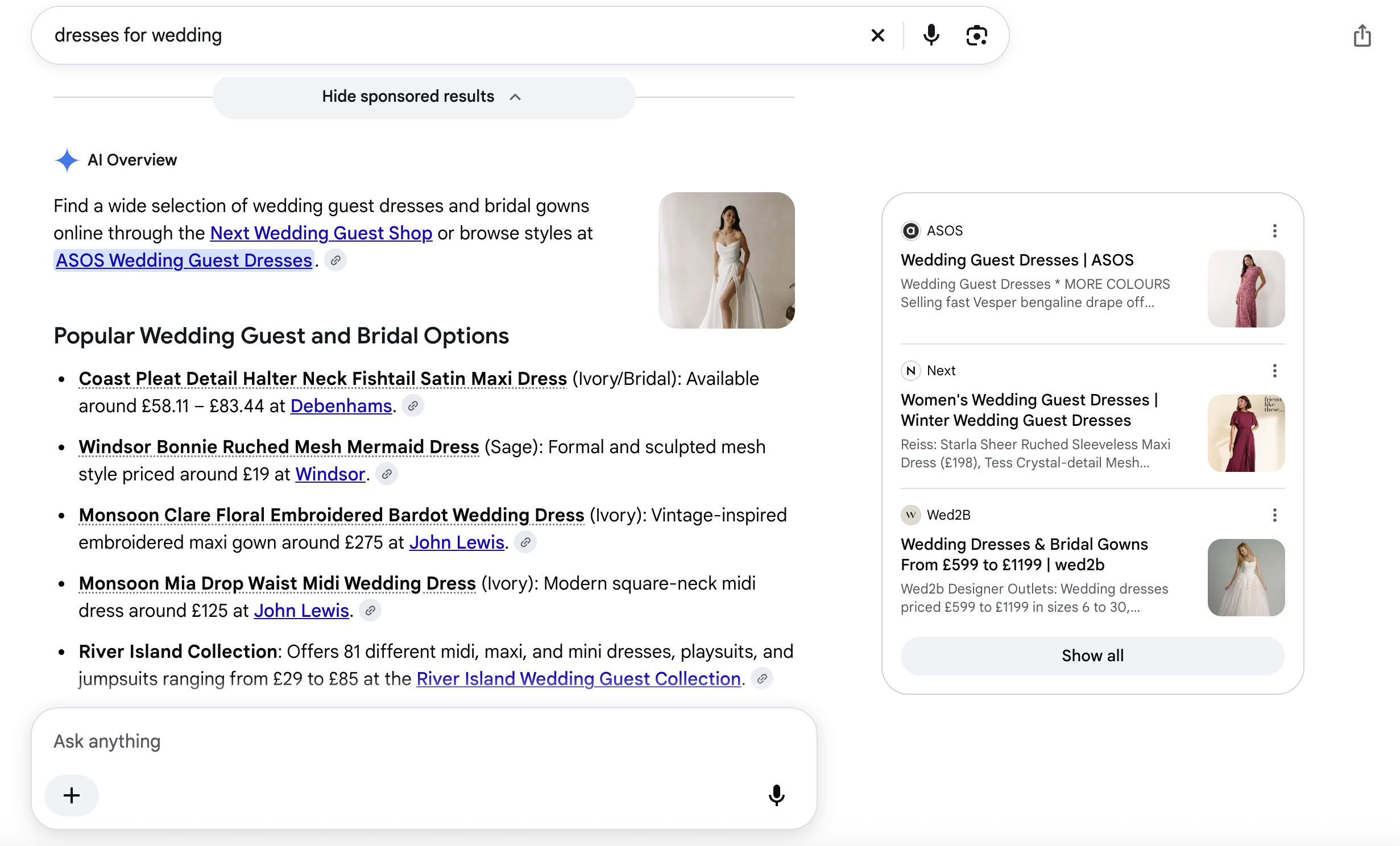
An example of a Google AI Overview at the top of the search results.
How do AI Overviews work?
Google doesn't show an AI Overview for every search. Google says AI Overviews "are only shown when our systems determine that it is additive to classic Search, and as such, often don't trigger" (Google Search Central).
When one does appear, Google may use a technique it calls "query fan-out." It runs several related searches across subtopics and data sources, then brings the results together into one answer. That's why an AI Overview can cite pages that aren't in the top results for the original search.
Since January 2026, Google has used its Gemini 3 model for AI Overviews (Google).
To be eligible as a source, Google says a page "must be indexed and eligible to be shown in Google Search with a snippet." There are no extra technical requirements.
How are AI Overviews linked to AI Mode?
AI Overviews and AI Mode are related, but they're not the same thing.
| AI Overviews | AI Mode | |
|---|---|---|
| Where it appears | At the top of the normal results page, for some searches | A separate, conversational search experience |
| What you get | A short summary with source links | A longer answer you can keep questioning |
| How people use it | A quick answer before scrolling or clicking | Exploring, comparing and narrowing down choices over several questions |
The two are now joined up. In many experiences, searchers can continue the journey by asking follow-up questions and moving deeper into AI Mode. Google confirmed in January 2026 that people can ask follow-up questions directly from an AI Overview (Google).
This changes the job for brands. Appearing in the first answer is only the start. The bigger opportunity is staying visible as the searcher keeps asking questions. Jon Earnshaw and I compared the two experiences in our webinar, Same Question, Different World: Navigating AI Overview vs AI Mode. Watch the full session here:
What is a zero-click result?
A zero-click result is when someone gets the answer they need on the search results page and doesn't click through to a website.
AI Overviews are incredibly helpful for users. The challenge for businesses is that people can get the answer before they ever click through to a website.
Pi's glossary describes it the same way. The searcher receives the answer "in a synthesized form directly on the page," which removes the need to click any website links.
Zero-click doesn't mean AI Overviews send no visitors. They link to their sources, and Google says that when people click from results pages with AI Overviews, "these clicks are higher quality," meaning people are more likely to spend more time on the site (Google Search Central). But fewer searches lead to a click, so clicks alone no longer show the full picture.
Independent research points the same way. In an April 2025 study of 700,000 keywords across five industries, Amsive found that keywords triggering an AI Overview saw click-through rates fall by 15.49% on average (Amsive).
Jon covers this shift in his brightonSEO talk, From Clicks to Conversations: Preparing for Zero-Click Search, where he explains how brands can prepare to be found and chosen when people get answers without visiting a website:
What do AI Overviews mean for your business?
If searchers can get their answer without clicking, success has to be measured differently. Organic success is no longer only about traffic. It's about whether your brand is visible, mentioned and trusted in the answer the searcher gets.
That means asking:
- Do AI Overviews appear for the searches that matter to us?
- When they do, are we cited or mentioned?
- Which competitors, publishers or creators are cited instead?
- Do we stay visible when the searcher asks follow-up questions in AI Mode?
A brand can rank well in the blue links and still be missing from the AI Overview above them. Equally, a page that isn't on page one can be cited. You need to see both.
It also means SEO can't work alone. An AI Overview summarizes several sources, so press coverage, expert content and social activity can all shape whether your brand is part of the answer. SEO, PR, social and content teams get further when they work toward shared measures such as Share of Voice and brand mentions, rather than separate channel targets.
How do you track AI Overviews?
Checking a few searches by hand gives you a snapshot, but AI Overviews change over time and don't appear for every search. To track them properly, look at four things across your full keyword set:
- Presence. Which of your keywords trigger an AI Overview, and how that changes over time.
- Citations. Which URLs are linked as sources, and whether any are yours.
- Mentions. Whether your brand is named in the answer, even without a link.
- Clicks. How click-through rates change for keywords where an AI Overview appears.
Track your competitors in the same way. Knowing who is cited when you aren't shows you where the gaps are, and what kind of content Google is choosing.
How do you get cited in AI Overviews?
Google is clear that there are no special tricks: "There are no additional requirements to appear in AI Overviews or AI Mode, nor other special optimizations necessary" (Google Search Central). What helps is doing the fundamentals well.
Focus on helpful content, strong expertise, clear structure and pages that answer specific search intent. Here's what that looks like in practice.
1. Make sure Google can find and show your page. It needs to be indexed and eligible to show a snippet. Keep important content in text, and link to it from related pages. Structured data isn't required for AI Overviews, but relevant markup (for example Article, Product or Organization) helps Google understand what a page is about. Make sure it matches what's visible on the page. Google's structured data gallery lists the types it supports.
2. Answer specific questions clearly. Use headings that match the questions people ask, and put the answer near the top before going into detail. People Also Ask is a good place to find those questions.
3. Give AI something worth citing. Google advises website owners to provide "unique, non-commodity content" (Google). At Pi, we use the DUO framework for this: content should be Deep, Unique and Original. Go far enough to help someone understand the subject or make a decision, and add evidence or a perspective that only you have. First-party data and original research are a strong example, because no one else can offer the same thing.
4. Show real experience. Our FAST framework asks whether content is Firsthand, Authentic, Social and Trusted. Involve the people with expertise, put their names on the content and show what they've done. Build author pages with job titles, experience and links to profiles such as LinkedIn, and earn mentions in trusted industry publications through digital PR. Short videos of experts explaining what they know are a good way to do this. Jon explains both frameworks in his guide to FAST and DUO content. Clear authorship also supports E-E-A-T.
This short sums up both frameworks in under 30 seconds:
5. Follow the conversation. Make sure you're following the conversation, so you stay visible as the searcher explores and discovers. Think about the next questions someone will ask after the first answer, and make sure your content answers those too.
How can Pi Datametrics help you track AI Overviews?
Pi's SERP feature tools show whether an AI Overview appears for your keywords and who is performing in it. Here's how that works:
- See where AI Overviews appear. Pi's SERP feature tracking tool shows which of your tracked keywords trigger an AI Overview, alongside People Also Ask, video results, Top Stories and other SERP features. Feature Visibility Timeline shows how that changes over time.
- See who is cited. Feature Explorer shows which pages, domains and creators are winning visibility in AI Overviews, so you can compare yourself with competitors. See how to track AI Overviews in Pi.
- Find your biggest opportunities. Put it together to see where AI Overviews appear for valuable searches, who is cited instead of you, and which content to improve first. Look for longer-tail searches where AI Overviews are missing or appear inconsistently too, since they can be openings for new content.

AI Overview tracking in Pi's Feature Explorer.
AI Overviews aren't going away, and they're changing what it means to be visible in search. Treat them as a new place to be found, not only a threat to clicks. Know where they appear, see who they cite, and build content that deserves to be part of the answer.
See who's winning AI Overviews in your market.Explore Pi's SERP feature tracking or book a demo.
🚀 Ready to turn AI Overviews into a growth engine for your brand?
Request demo



Never miss a post
Join our mailing list and have our SEO news delivered straight to your inbox.