
From clicks to conversations: Preparing for an agent-driven world
By Jon Earnshaw|07 May 2026|6 min read
For 25 years, search engines helped us find information. We typed in a query, Google returned a list of blue links, and we decided what to do next.
Over the last 12 months, that relationship has started to change.
I recently spoke at BrightonSEO about how search is shifting from clicks to conversations, and why brands now need to prepare for an agent-driven world.
AI systems are increasingly shaping decisions, not just discovery. As that happens, brands are no longer simply experienced by users, they are interpreted by machines.
That changes how visibility works.
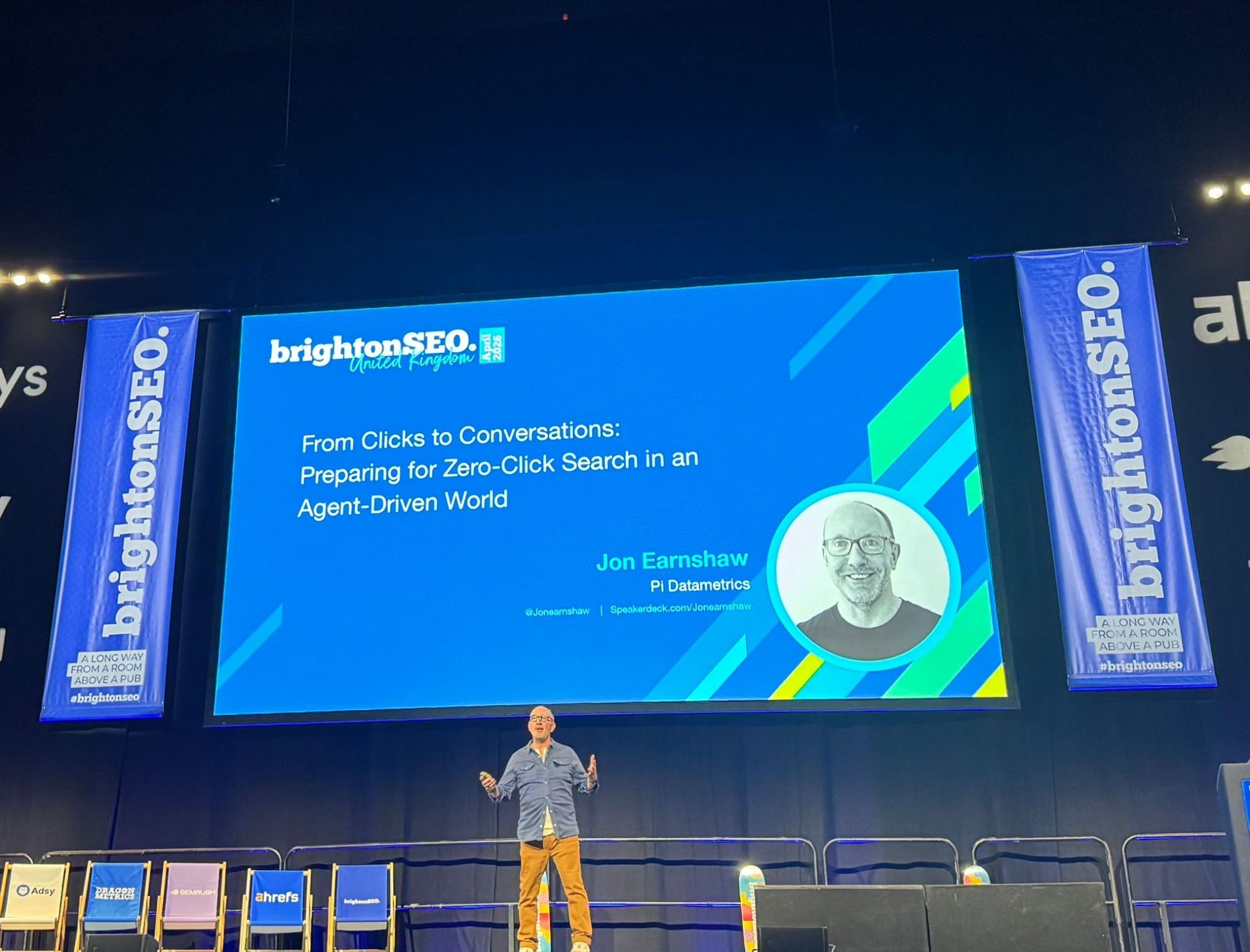
Download the slides and recording
Brands are no longer experienced. They are interpreted.
When an E-commerce agent completes a purchase or recommendation on behalf of a user, the brand may never get the opportunity to perform its brand in the way it traditionally has.
The user may never visit the website, experience the design system, read the about page or interact with the carefully crafted customer journey the business invested in.
Instead, the machine reduces the brand to a set of attributes. Specifications, pricing, reviews, availability, delivery speed, return policies and suitability signals become the material AI systems use to interpret and compare brands.
That changes the question businesses need to ask.
For years, search teams focused on rankings. But in an agent-driven world, the more important question becomes:
“How does my brand survive being interpreted by machines?”
Because if commerce becomes agentic, then search interfaces inevitably become conversational. There is no meaningful role for AI agents inside a traditional list of blue links. They need conversational environments where decisions can be refined, clarified and acted upon over multiple turns.
Download the slides and recording
The interpretation stack
If machines are going to interpret brands, then we need to understand what they are actually interpreting.
During the session, I introduced what I call the Interpretation Stack: Input, Novelty, Threads, Entities and Reputation. These are the areas that increasingly determine whether a brand enters, survives and persists within AI-driven conversations.

- Input matters because AI systems are increasingly prioritising first-hand, experience-led and genuinely useful information. This goes far beyond ticking E-E-A-T boxes. Generic content becomes vulnerable in conversational environments because machines compress it. And when content gets compressed, it loses identity.
- Novelty matters because AI systems are trying to surface differentiated information rather than endless variations of the same thing. Depth, originality and perspective increasingly become competitive advantages.
- Threads are perhaps the most misunderstood part of the shift. The industry is still heavily focused on prompts, but AI search does not behave like traditional keyword search. Users refine their thinking as they go. They compare options, expand context and continue conversations over multiple turns. Visibility can no longer be measured by a single response because the conversation itself keeps evolving.
- Entities become increasingly important because agents do not see brands in the way humans do. They see attributes. Product feeds, specifications, reviews, pricing consistency and structured information all contribute to how a machine interprets a business.
- Then there is reputation. Historically, brands could control much of their narrative through their own website. AI systems now evaluate brands across the wider ecosystem. Your reputation increasingly becomes what the ecosystem agrees you are.
Download the slides and recording
Stop obsessing about prompts
The industry has become increasingly focused on prompts and prompt-level visibility.
You can’t really optimise for a prompt because prompts constantly change. If you’ve ever wondered what prompts should I be tracking for LLMs, the reality is that users refine intent, compare options and expand context over multiple turns.
It’s not really a prompt, it’s a conversation.
Traditional SEO strategies were built around keywords and ranking targets. But conversational discovery behaves differently. Visibility increasingly depends on understanding how conversations evolve and whether your brand remains present as decisions become more specific.
During the session, I used the example of barbecue to explain this shift. One of the biggest opportunities turned out not to be the barbecue itself, but the surrounding conversational spaces: accessories, upgrades, maintenance, fuel choices and ease of use.
That is where modern visibility increasingly sits.
What this means for brands
If conversations become the interface, then visibility can no longer be measured through isolated prompts alone.
Brands often appear early in conversational journeys and disappear later as intent becomes more specific. As conversations evolve, AI systems begin looking for greater depth, stronger contextual understanding and clearer evidence.
The opportunity is no longer just appearing once. It is remaining present as conversations evolve and decisions become more refined.
This is exactly why we’ve been focused on helping brands understand conversational presence rather than isolated prompt visibility. Understanding where brands remain present, where they disappear, and which conversational spaces create opportunity is becoming increasingly important as AI-driven discovery evolves.

Image source: Pi’s AI Search Visibility Tool
The businesses that adapt early will have a significant advantage.
That starts with preparing brands to be interpreted properly through stronger entity signals, clearer structured information and more differentiated content. It also means understanding the conversations that actually matter, not just the prompts that start them.
Search is moving from clicks to conversations, from rankings to interpretation, and from isolated prompts to evolving conversational journeys.
The brands that succeed will not simply be the brands that rank.
They will be the brands that remain present throughout the conversation.
Download the slides and recording




Never miss a post
Join our mailing list and have our SEO news delivered straight to your inbox.