Put the brakes on: why so much content is forgettable
By Jon Earnshaw|11 Nov 2026|8 min read
I'm calling for a pause.
In our webinar on 3 November, I said something big was about to happen, and that it was going to bite us all. A week later, Google began rolling out the November 2026 core update.
Google says the update is designed to surface "relevant, satisfying content." So ask yourself honestly: how much of yours is?
Too much content today is scaled, near-identical and instantly forgettable. And I still expect a much bigger spam update before the end of the year.
So before you publish more, stop. Make the content you already have worth coming back to. Not vanilla. Not forgettable. Something people would actually bookmark.
Less is more. We don't need more and more content. We probably need less and less, but with more and more depth.
The rollout started on 10 November and may take up to two weeks. You can follow it on the Google Search Status Dashboard. This isn't a pause on publishing forever. It's a proper look at what we publish, and why.
Here's what's been bothering me. Between chasing page one, ticking algorithm boxes and scaling production, too much content became interchangeable. Perfectly readable. Instantly forgettable.
And when content stops working, the industry's answer is often "publish more."
I think that's the wrong answer. Google is now saying, quite openly, that scaled content is a growing problem. So in this post I look at why so much content is forgettable, what vanilla content looks like next to the real thing, what Google has said and done about scaled content, and what I'd review before publishing another page.
Watch the webinar
I covered this in our 3 November webinar, "Everyone's Talking AI. What's Happening to Your SEO?"
Perfectly readable. Instantly forgettable.
When was the last time you bookmarked a piece of content?
There was a time when great content earned a bookmark. I bookmarked everything I found that was interesting, that had depth, that was unique. Mostly I bookmarked it because I was worried I'd never find it, or anything like it, again.
I don't bookmark anything today. Nothing is worth bookmarking. If I read something interesting, I know I can find somebody else who has written exactly the same thing. And somebody else after them. As I said in the webinar:
"The reason I believe we don't bookmark content anymore is it just doesn't matter. Because if I'm reading something today, unless it's astonishingly good and unique, when I come back tomorrow, I'll just search for something even better, even fresher."
That's the problem. So much content gives information without earning confidence. It answers the question, but it gives nobody a reason to remember who answered it, or to come back.
When a thousand pages say the same thing in the same way, none of them matter much. That goes for readers, and for the search engines and AI systems deciding which sources to show.

What vanilla content looks like
Let me show you what I mean with an example: planning a trip to New York for Christmas.
British Airways has a guide to New York. On paper it ticks the boxes. It has a big hero image and an author's name. But read it as a traveler and it falls apart.
- The full-width image at the top has nothing to do with the content underneath it.
- The copy tells me things I already know. New York is "the city so nice they named it twice." I've seen that line before. We all have.
- It talks about downtime in Central Park and Shakespeare in the Park, but it's written in the third person, with no photos from the writer and nothing that tells me they've been.
- The only links point to British Airways' own sales pages.
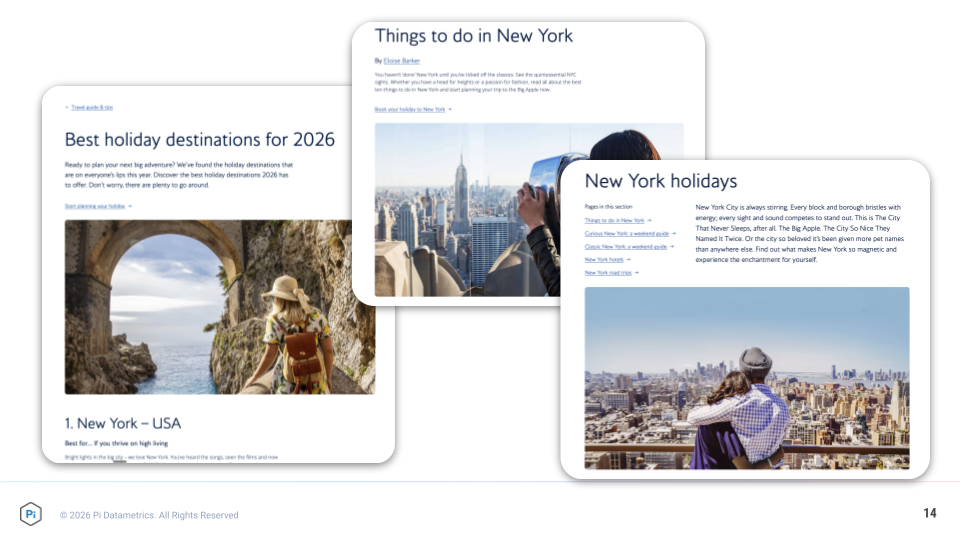
It's information anyone else could give me, and I have zero confidence in any of its recommendations. What's missing is firsthand experience, honesty and detail. Where should I go? What should I avoid? Help me. Give me a reason to remember you.
Now compare it with Adventurous Kate's "What NOT to Do in New York". Kate writes as a New York resident. She tells you which mistakes tourists make and what to do instead. She's honest about how brutal New York winters are, and tells you exactly where to pick up hats, gloves and a better coat if you've packed wrong. I learned that lesson the hard way a few years ago. And she gives advice only someone who lives there would give: "for the love of God, don't stop in the middle of the sidewalk."
That's firsthand, authentic and trusted. It will beat the brand's guide any day of the week, because the brand's guide is the kind of content that gets collapsed into a generic summary and forgotten.
Google: scaled content is now a bigger problem than link spam
At Google Search Central Live in Barcelona on 2 October 2026, Gary Illyes talked about why Google keeps updating how it judges quality. According to ROAST's recap of day 3, one of his reasons was spam, and his warning was that scaled content is now becoming more of a problem than link spam.
That comparison should make every content team stop and think. Many of us remember what happened with link spam. As I put it in the webinar:
"Penguin annihilated websites that had built their entire reputations on the back of false authority through links."
If scaled content is now seen as a bigger problem than that, we should take it seriously.
The scale is huge. Google says "Our systems find 40 billion spammy pages every day" (How Google detects spam). It isn't a new number, since Google first reported it in its webspam report for 2020, but Illyes repeated it in Barcelona.
It wasn't the only quality message of the day. ROAST's recap also covers Duy Nguyen, a Search Quality Analyst at Google, who said AI makes content easy to create and that this is flooding the web with low quality pages. His point was that quality matters, not who or what wrote it. He also said there have been more spam updates recently because there is so much more new content.
SpamBrain and the missing piece of the jigsaw
Google describes SpamBrain as its AI-based spam-prevention system. Think of it as a jigsaw with three pieces.
In March 2024, Google announced three new spam policies:
- Expired domain abuse: buying expired domains and filling them with low-value content to borrow their old reputation.
- Site reputation abuse: third-party pages hosted on a trusted site to ride on its authority, such as affiliate content in a subfolder of a news site.
- Scaled content abuse: producing lots of pages mainly to manipulate rankings, however they're created.
The same month, Google's March 2024 core update targeted unoriginal content. When it finished rolling out, Google said "you'll now see 45% less low-quality, unoriginal content in search results versus the 40% improvement we expected" (Google, March 2024, updated 26 April 2024).
The first two pieces have hit home. Site reputation abuse is the one most people saw. Betting content hosted on The Independent's site, which had ranked for big-money gambling terms, lost that visibility after Google began enforcing the policy in May 2024.
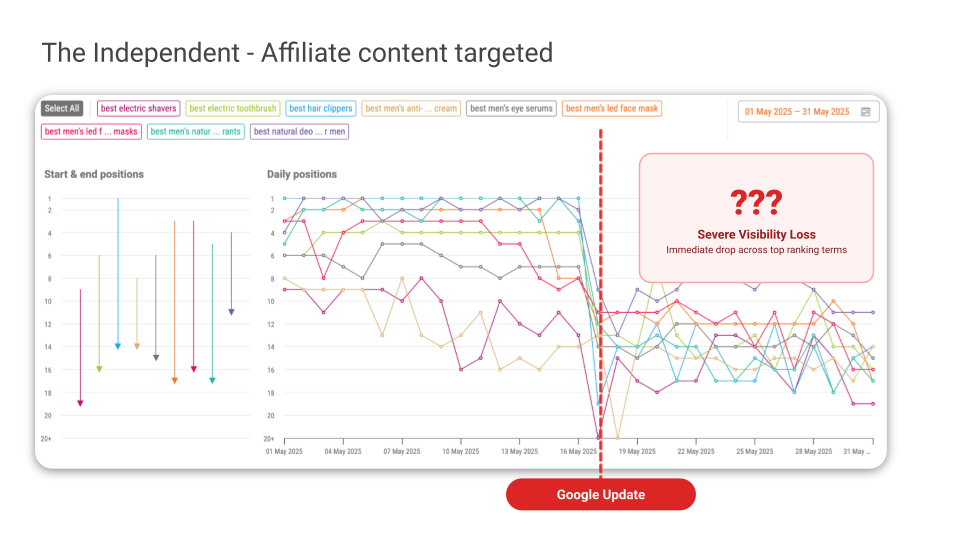
That leaves the third piece. In my view, scaled content is the gap Google is now focused on, and I don't think most brands are ready for it. I'd rather we fixed our content before enforcement tightens than after.
We've already seen how much movement a spam update can cause. In our analysis of the Google September 2026 spam update, we saw sharp declines across eSIM brands, established publishers and major health sites, including the NHS. Google didn't name a specific target for that rollout, so those charts are a starting point for investigation, not proof that any site broke the rules. But they're a warning for anyone whose content plan has become "more of the same." For the basics, see our guide to what a Google spam update is.
What Google's scaled content abuse policy says
Google's spam policies for Google web search define scaled content abuse as "when many pages are generated for the primary purpose of manipulating search rankings and not helping users." The policy adds that it's typically about large amounts of unoriginal content that gives little to no value to users, "no matter how it's created."
Google's examples include:
- Using generative AI or similar tools to generate many pages without adding value for users
- Scraping feeds, search results or other content to generate many pages, including by synonymizing or translating it, where little value is provided
- Stitching or combining content from different web pages without adding value
- Creating multiple sites to hide the scaled nature of the content
- Creating many pages that make little or no sense to a reader but contain search keywords
Notice what this isn't. It isn't a ban on AI. It's about volume without value, whether a person or a tool produced it. "We used AI" isn't the risk. "We published thousands of pages nobody needed" is.
Fake E-E-A-T is a patch, not a fix
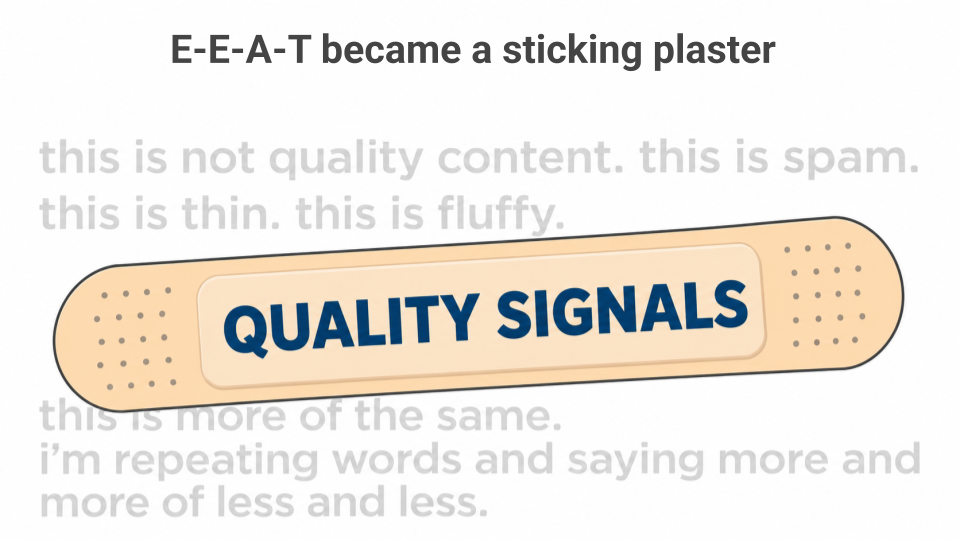
When content wasn't good enough, a lot of us reached for quality signals instead of quality. In the webinar I called it a sticking plaster over content. A page gets published, the first question is "who wrote it?", and the answer was often invented:
"People were making up authors, fake authors, fake bios, and the advice kind of became just make it look like it was written by a human."
That misses the point of E-E-A-T entirely. As we explain in our guide to Google E-E-A-T, it isn't a box to tick or a single ranking factor. It describes what Google wants to reward: content from people with real experience and expertise, who have earned authority and can be trusted.
And here's the thing. Patching with signals used to work. I've given that advice to a lot of brands over the years, and it was relatively easy. It won't work anymore unless there is real authenticity underneath.
You can't fake that with a stock photo and a made-up bio. Author pages should show genuine expertise, not exist because someone said they're SEO best practice. If the content underneath is forgettable, the badge on top won't save it.
The more fluff you have, the fewer citations
This matters for AI search as much as classic search. An AI answer will only send someone to your page if there's a reason to. If your content says the same as everyone else's, it won't be synthesized, and it won't be cited.
Here's how that plays out in the copy on a typical page:
- Earns a citation: a specific claim with the proof linked, such as "our platform reduced churn by 30%," with a link to the research behind it.
- Earns nothing: "game-changing solutions," "built for modern teams," "revolutionary, innovative, disruptive." Everyone says it, so it gets collapsed.
- Earns a citation: a result you can show, with a link through to the data and the reason it happened.
- Earns nothing: "better results" on its own, with nothing to back it up.
The same goes for products. If your product description is the same as three other retailers', there's no reason for an AI system to choose yours. Google has given retailers a way to add depth here. Merchant Center now has six conversational attributes: questions and answers, document links, related products, item group titles, variant options and popularity rank. They let your product data answer the follow-up questions people ask, such as whether a backpack fits a 16-inch laptop, or what zip it uses.
And this will only matter more as personal AI agents start talking to business agents. When that happens, the imagery, the video and the brand language get stripped away, and what's left is a set of attributes. If yours are the same as everyone else's, you've got nothing to stand on.
Put the brakes on: four things to review now
So here's the pause I'm asking for. Before the next batch goes into the content calendar, look at what you've already published. These are the four things I'd review first:
- Near-identical pages. The templated stuff. If you've got it, you know about it.
- AI content with no added value. That includes AI content that doesn't say where AI was involved in creating it.
- Misleading authorship. A real person should stand behind the content, with real experience of the subject. Not a company name, and not a writer who has never touched the product or been to the place.
- Outsourced content. Anything written by people who don't know your brand, your product or your customers. And anything that wasn't genuinely designed to answer questions and solve problems, but exists because "we need more content."
Google's own guidance on creating helpful, people-first content asks the same questions: who created the content, how it was created and why. And its spam policy says that if you're hosting scaled content on your site, you should exclude it from Search. Looking back at what you've already published matters as much as deciding what comes next.
Then, before you publish anything new, ask:
- Would anyone bookmark this, or come back to it?
- What do we know, or what have we done, that others haven't?
- If another company could publish this page without changing a word, why are we publishing it?
- Who really wrote it, and why should a reader trust them?
- Does it earn confidence, or does it only give information?
None of this means publishing less for the sake of it. It means publishing with a reason.
What to review your pages against
During this pause, this is what I'd review those pages against. At Pi we use two frameworks, FAST and DUO, and they sit alongside each other.
FAST is about the experience and credibility behind the content:
- Firsthand: what do we know that others don't?
- Authentic: if another company could publish this without changing a word, it isn't ours.
- Social: content shouldn't begin and end with the website.
- Trusted: who created this, and why should anyone trust them?
DUO is about what the content adds:
- Deep: depth isn't word count. Go beyond the first question.
- Unique: contribute something that couldn't easily be recreated by someone else.
- Original: if your content says the same as anyone else, it won't be synthesized.
I've set out how we use them in how to create content that performs.
Time to put the brakes on
The temptation when visibility drops is to produce more. More pages, more keywords, more output. But Google is telling us that scaled content is a growing problem, and readers have already stopped bookmarking.
We don't need more and more. We probably need less, with a lot more depth.
So before we produce another thousand pages, let's ask whether we've given anyone a reason to read the last one.
Time to put the brakes on.



Never miss a post
Join our mailing list and have our SEO news delivered straight to your inbox.