
What is a Google Spam Update? Everything you need to know
By Jon Earnshaw|28 Sep 2026|4 min read
Google Spam Updates are significant improvements to Google's spam detection systems, designed to reduce the visibility of websites and pages that violate Google's Search Spam Policies.
Powered by Google's AI-based SpamBrain system, these updates identify manipulative practices such as scaled content abuse, expired domain abuse and site reputation abuse, improving the quality and relevance of Google's search results.
Unlike Google Core Updates, which broadly reassess the quality signals websites send across the web, Spam Updates focus specifically on identifying spam and reducing the visibility of content created primarily to manipulate search rankings rather than help users.
In this guide, you'll learn what Google Spam Updates are, how SpamBrain works, what Google considers spam, how to determine whether your website has been affected and the steps you should take if your visibility changes.
Latest Google Spam Updates
Google has confirmed four Spam Updates so far in 2026, with updates rolling out in March, June, August and September.
September 2026 Spam Update
Google’s September 2026 Spam Update rolled out from September 24 to October 8, 2026. The rollout is now complete and applied globally across all languages.
I’ve been investigating the changes with the team at Pi, including sharp visibility losses across selected searches for established publishers and health sites such as Byrdie, Healthline and the NHS.
Read my analysis of the September 2026 spam update for the charts, what caught my attention and what I’d be checking on your own site.
August 2026 Spam Update
The August 2026 Spam Update rolled out between 18 August and 21 August 2026, taking 2 days and 16 hours to complete.
The update applied globally and across all languages. Google didn't announce any new spam policies or identify a particular type of spam targeted by the update.
June 2026 Spam Update
The June 2026 Spam Update rolled out between 24 June and 26 June 2026.
The update applied globally and across all languages. Like other Spam Updates, it was designed to improve Google's ability to identify websites and pages that violate its Search Spam Policies and reduce the visibility of manipulative content.
While Google's SpamBrain system continuously works to detect spam, Google occasionally announces major Spam Updates when significant improvements are made to its detection systems.
March 2026 Spam Update
Google's first Spam Update of 2026 rolled out between 24 March and 25 March 2026.
The update applied globally and across all languages. Google didn't announce a specific spam policy change or identify a particular type of spam targeted by the update.
Together, these updates reflect Google's continued investment in detecting manipulative practices and improving the quality of its search results.
We'll continue updating this guide whenever Google confirms a new Spam Update, providing rollout dates, an overview of the changes and practical guidance on understanding their impact.
Looking for every confirmed Google update? Explore our Google Algorithm Updates hub for the latest Core Updates, Spam Updates and other confirmed changes to Google's search systems.
What is a Google Spam Update?
A Google Spam Update is a significant improvement to Google's automated spam detection systems, designed to identify and reduce the visibility of websites and pages that violate Google's Search Spam Policies.
These updates are powered by SpamBrain, Google's AI-based spam prevention system, which continuously analyzes websites to detect manipulative practices intended to influence search rankings.
Unlike Google Core Updates, which broadly reassess the relevance and quality of content across the web, Spam Updates focus specifically on identifying content and behaviors that Google's systems consider spam.
The purpose isn't simply to penalize websites. Spam Updates are designed to improve the quality of Google's search results by reducing low-value, manipulative content and surfacing more helpful, trustworthy information for users.
Because SpamBrain operates continuously, many spam improvements happen without a confirmed update. However, when Google announces a Spam Update, it usually reflects a significant improvement to its spam detection systems that can have a noticeable impact across Search.
What does Google consider spam?
Google doesn't consider content spam simply because it's written with AI or published at scale. Instead, Spam Updates target content and practices designed primarily to manipulate search rankings rather than provide genuine value to users.
While Google's Search Spam Policies cover a wide range of practices, recent Spam Updates have placed particular emphasis on three areas:
Scaled content abuse
Scaled content abuse refers to the mass creation of pages designed primarily to manipulate search rankings rather than provide genuine value to users.
This content may be generated using AI, human writers or a combination of both. The issue isn't how the content was created, it's why it was created.
Google defines scaled content abuse as producing large amounts of content with the primary purpose of ranking in search results rather than helping people.
Examples might include:
- Publishing hundreds of near-identical location or product pages with little unique value.
- Creating large volumes of articles that simply reword existing information.
- Producing content at scale without original expertise, research or insight.
- Automatically generating pages designed solely to capture search traffic.
As AI content creation becomes more accessible, Google's systems are increasingly focused on distinguishing genuinely useful content from pages created primarily to increase search visibility.
High-quality AI-assisted content can still perform well. The difference lies in whether the content genuinely helps users, demonstrates expertise and provides original value.
Expired domain abuse
Expired domain abuse involves purchasing an established domain primarily because of its existing authority and backlink profile, then using it to publish unrelated content in an attempt to inherit rankings.
For example, an expired education website might suddenly become a casino affiliate site, or a former local business website could be repurposed to publish financial content.
While legitimate domain acquisitions happen every day, Google's systems look for situations where the previous reputation of a domain is being exploited to manipulate search rankings rather than continue serving users.
The stronger the disconnect between a domain's history and its new purpose, the more likely Google's systems are to identify it as spam.
Site reputation abuse
Site reputation abuse occurs when third-party content is published on an authoritative website primarily to benefit from that website's existing reputation in search.
This often happens when websites publish content that falls outside their core expertise, allowing another organization to use their authority to gain rankings they may not otherwise achieve.
Examples have included voucher content, betting pages and affiliate articles published on large news websites with little editorial oversight or connection to the publisher's primary purpose.
Google isn't penalizing partnerships or guest contributions. The concern is whether content exists primarily to exploit the authority of the hosting website rather than provide genuine value for its audience.
As search continues to evolve, Google is placing greater emphasis on topical authority and demonstrating expertise within a subject area, making site reputation abuse increasingly difficult to sustain.
Why these changes matter
Spam Updates aren't simply about removing low-quality websites. They're part of Google's ongoing effort to improve the quality of Search by reducing manipulative content and rewarding websites that demonstrate genuine expertise and value.
I don't believe Google is simply removing content from the search results. It's making room for something better.
For brands and publishers, the direction is clear. Long-term success comes from building topical authority, creating original content and earning trust over time, rather than relying on tactics designed to manipulate rankings.
As Google's systems continue to evolve, they'll become increasingly effective at distinguishing content created for search engines from content created for people. The websites that succeed will be those that consistently provide something useful, original and worth surfacing.
Has your website been impacted by a Google Spam Update?
If you think your website has been impacted by a Google Spam Update, don't rush to make changes. Start by understanding what actually changed.
Unlike a manual action, Google won't notify you if your website has been affected by a Spam Update. Instead, you'll typically see changes in organic visibility, rankings or traffic around the time the update rolled out.
Before making any decisions, you need to understand the scale and nature of the impact. Did visibility decline across your entire website, or only specific categories? Were particular templates or content types affected? Did competitors experience similar changes, suggesting a wider algorithm update rather than an issue unique to your website?
Pi's SEO Platform helps enterprise SEO teams answer these questions quickly. By monitoring search visibility across millions of keywords, categories, landing pages and competitors, Pi makes it easy to understand how a Spam Update has affected your website and where to focus your investigation.
Rather than relying on a handful of tracked keywords, Pi helps you identify patterns across your entire search landscape, separating normal ranking fluctuations from genuine algorithm impact and highlighting the areas most affected by the update.
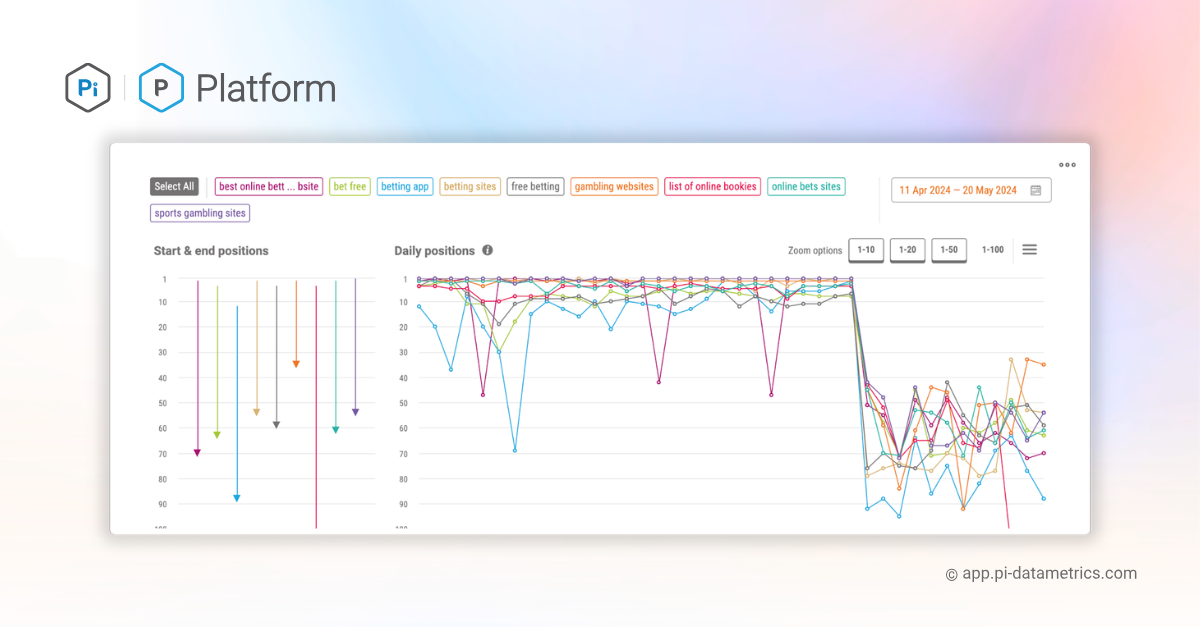
Image source: Pi's Rank Tracker Position Explorer Chart
Using Pi Datametrics, you can investigate the impact of a Spam Update by monitoring:
- Overall Visibility Index before, during and after the update.
- Changes across keyword groups, categories and landing pages.
- Which sections of your website gained or lost visibility.
- Competitor performance throughout the rollout.
- Long-term visibility trends rather than day-to-day fluctuations.
Once you've identified the affected areas, review the content objectively and look for common themes.
Ask yourself:
- Does this content genuinely help users?
- Does it demonstrate expertise or simply repeat information available elsewhere?
- Was it created to answer a real user need or primarily to attract search traffic?
- Does it still deserve to rank today?
If you identify recurring issues, focus on addressing the underlying problem rather than chasing quick fixes. That may mean improving, consolidating or removing content that no longer provides meaningful value.
Can you recover from a Google Spam Update?
Yes. Recovery is possible, but it rarely comes from making one small change or waiting for the next update.
Recovery is about demonstrating to Google that your website deserves to rank by consistently providing valuable, trustworthy content that puts users first.
That may involve:
- Removing or consolidating low-value pages.
- Updating outdated or repetitive content.
- Demonstrating greater expertise and authority.
- Improving the usefulness of key landing pages.
- Ensuring every page has a clear purpose for users.
Rather than trying to reverse engineer the algorithm, focus on building a better website. Over time, that's exactly what Google's Spam Updates are designed to reward.
Improve your visibility with Pi Datametrics
Understanding that a Spam Update happened is only the first step.
The real value comes from measuring its impact, identifying the pages affected and understanding how your visibility compares with the rest of your market.
Pi Datametrics helps enterprise SEO teams monitor Google's algorithm updates, measure changes in search visibility and uncover the opportunities that matter most.
Book a demo to see how Pi Datametrics helps you measure algorithm updates, identify performance changes and build a stronger long-term SEO strategy.



Never miss a post
Join our mailing list and have our SEO news delivered straight to your inbox.