
Beyond your website: three ways to measure search visibility
By Peter Longton|13 Oct 2026|5 min read
“Where does my website rank?” used to be the question. Now our customers want to know whether AI recommends their products, who’s talking about their brand and where their content appears beyond their own site.
That shift was the focus of my first brightonSEO talk in October 2026, “From Measuring Search to Measuring Everything.” I shared three practical ways we’re helping customers measure their wider search presence, using lessons from traditional search.
Watch the recording below, or download the slides to follow along.
Get the talk slides
And because every story needs a starting point, mine begins in 2020, when I joined Pi and they promptly shut the pubs.
There was another change that made our work particularly important. As I shared in the talk, online shopping increased by 20%, and 90% of that shift never went back. The move online stayed with us.
Back then, customers mainly came to me asking, “Do I rank for this keyword?” I could look at their performance, competitors and search demand to understand their progress.
If we took the analysis a step further, we’d look at a group of keywords. That might represent a category within a business, a brand a retailer stocked or a topic for a publisher. For customers working internationally, we’d compare those groups across markets. What did the competitor landscape look like in Japan versus the US? How did their content perform?
But search was shifting, and the questions shifted with it.
1. Measure the feature opportunity
Search results got a lot less “blue-linky,” as I put it in the talk. Our customers started asking different questions. How do we target People Also Ask? How do we appear in video results? How do we get into the product card?
People Also Ask gave customers an opportunity to answer product questions, helping people in search and on their own sites. Video carousels gave them another way to reach their audience. Product cards became an important part of the picture for retailers too.
Then AI Overviews arrived. Initially, the concern centered on informational searches. As they appeared on transactional searches too, the question from customers became, “What impact is this going to have on our business?”
In the transactional fashion search landscape I showed at brightonSEO, two in three searches had an AI Overview. For ecommerce businesses, this was no longer only an informational-search issue.
There was plenty of panic. But I’m not here to add to it. The useful question is: what can we do next?
We needed to understand that impact across their search results. AI Overviews also represented a different opportunity, and customers began looking at their presence across AI search as well as traditional search.
Product features across AI search
For both AI search and traditional search, we need to look at features.
Product cards now appear within AI search responses too. We’ve started helping customers understand whether they appear as a link in the response text, a cited URL, a source panel URL or a recommended seller.
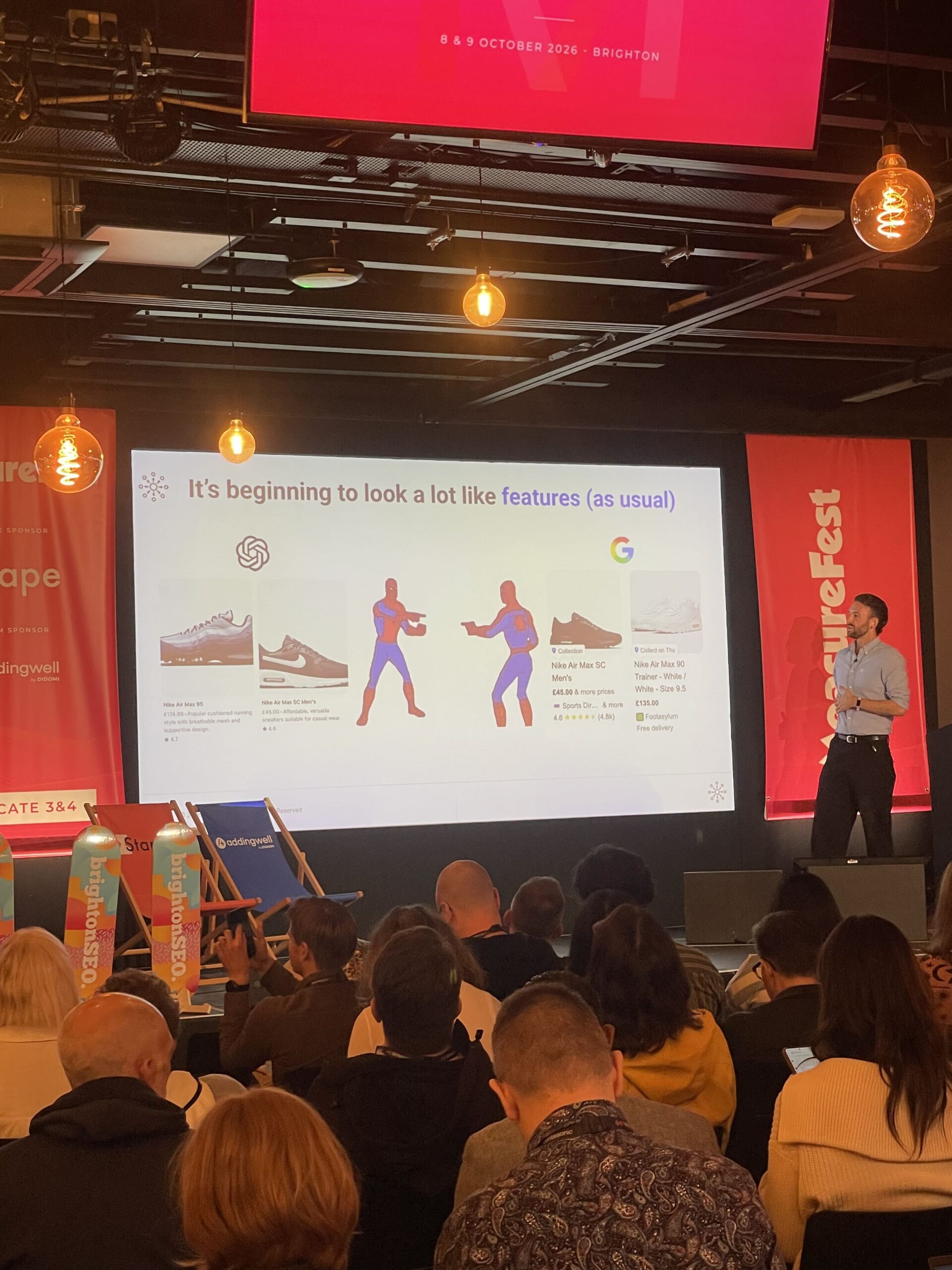
There’s something familiar here. We’ve been measuring features in Google for years. Now we need to understand them across AI search platforms.
For our ecommerce customers, one practical starting point is their product feed. We use the product titles to understand whether they appear as a recommended seller when those products are returned.
Rather than trying to capture every possible prompt that might lead to a product recommendation, we can ask a more focused question: when this product is recommended, are we one of the sellers recommended alongside it?
We need to analyze how often the product feature appears, then measure our presence overall and within that feature.
As agentic ecommerce develops, this becomes an important question. If a purchase journey takes place without human involvement, the recommended seller is likely to be the one the agent makes the deal with. We need to be able to measure that presence.
This is what we’re helping customers measure with Pi’s AI Shopping Tracker: whether their products appear, where their website is cited and whether they’re recommended as the seller.
A luxury fashion customer example
For one luxury fashion customer, we took products from their feed and looked at three levels of presence.
First, we looked at brand presence: whether they were cited, mentioned or a feature owner. That gave us a baseline.
Then we looked at feature presence: whether they appeared as a recommended seller within the product feature. In the luxury fashion example I shared, a product feature appeared in 86% of the product-title queries we measured. The customer was recommended as a seller in 17.9% of those queries.
Those figures gave us a benchmark and showed the size of the opportunity. The feature appeared frequently, but the customer wasn’t always one of the sellers recommended within it.
Finally, we looked at listing presence. A product feature contains multiple items, so we examined the individual listings to see whether the customer appeared as the recommended seller.
Together, those measures gave us a view of the customer’s presence across the funnel: overall, within the product feature and within its individual listings.
This gives the customer a benchmark and a view of the opportunity. It’s the kind of measurement we’ve done in Google for years, applied to AI search.
2. Track the conversation you want to be part of
The next point from my talk was: don’t obsess over the prompt.
We’ve had customers ask about tracking thousands, or even hundreds of thousands, of prompts to capture every possible way someone might find them.
But you can’t capture every variation. And even if you could collect all that data, what would you do with it?
Focus on the conversations you want to be part of and, if you sell products, the products that matter.
Jon Earnshaw explores this in more detail in his article, What prompts should I be tracking for LLMs?, including how we map the conversations that matter to your audience.
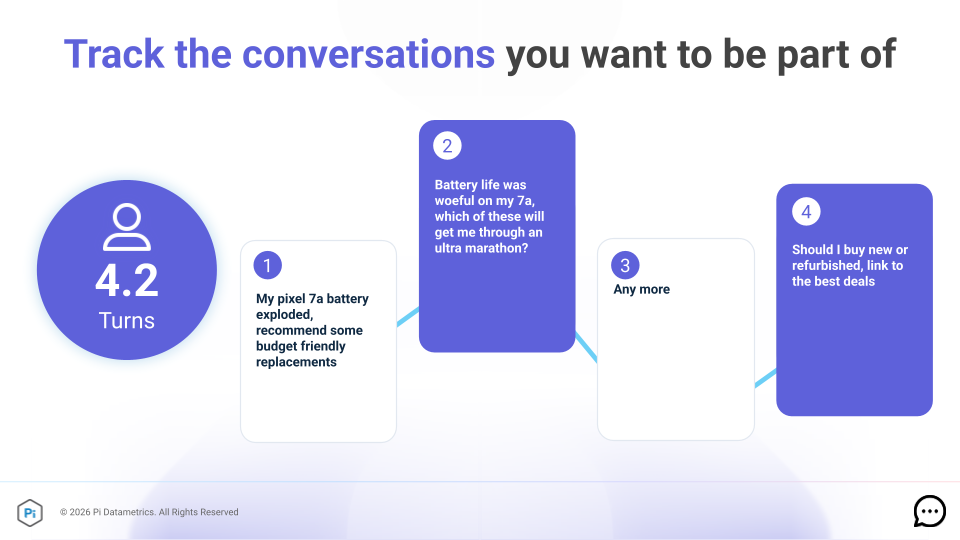
An individual prompt won’t necessarily represent what your audience is using. Your audience also goes on a journey. In the talk, I cited an average of 4.2 turns in an AI search conversation. People start with a question, then refine the response until they get what they need.
We need to understand the conversation, whether the focus is products, video or another area relevant to the business.
From a broken phone to a buying decision
Let me give you an example from my own life: buying a phone.
My Pixel 7a battery had a problem. A nightmare. So I needed some budget-friendly replacement recommendations. That was my first question.
Then I remembered what I really disliked about my old phone: charging it at lunchtime, then again in the evening. I needed battery life that would get me through an ultramarathon. Yes, I was determined to get the ultramarathon into the talk.
The AI had already given me six recommendations. Naturally, as someone who suffers from decision paralysis, I asked for ten. Why make the decision easy?
Once I’d chosen a phone, I asked whether to buy new or refurbished, with links to the best deals. It gave me a new price and a target price for a refurbished phone. As someone from Yorkshire, I appreciated that.
The conversation moved from recommendations to battery life, more alternatives and, finally, where to buy.
Tracking one of those prompts would only show one part of that journey. The conversation we want to understand is the one that leads to buying an affordable phone, including the refinements along the way.
Include brand listening
We also need to look at brand listening.
That’s more commonly associated with social, but whether our brand is mentioned in an AI response matters too.
We need to know whether our brand is mentioned, who is talking about it and whether those mentions are positive, neutral or negative.
An AI response might discuss our brand using content from YouTube, Reddit, a publisher or a review site. Our own website doesn’t have to be the source for our brand to be part of the answer. That’s why mentions, citations, sources and sentiment all matter.
3. Include social and YouTube in your search reporting
My third point was that we need to make friends with our social teams.
We’ve been talking about search and social teams working together at brightonSEO for years. The time has come to make those friends. We need to understand what’s happening across social and include it in our wider view of visibility.
With YouTube search, that means understanding whether your channel appears, alongside which creators appear for searches relevant to your audience. Their videos may influence buying decisions, so this gives us a useful view of the content our audience can discover.
In the talk, I showed Pi’s YouTube Explorer as part of this measurement. It helps us investigate channel and creator presence beyond the website.
At Pi, we’re moving beyond measuring a website to understanding a brand’s wider search presence. Our Brand Entities approach lets us define the websites, social assets and brand-name variations we want to analyze across traditional search and AI conversations. That means looking at where our own content appears, where our brand is mentioned and which third-party sources are representing it. Alongside measuring whether we’re recommended as a seller, this gives us a wider view of our brand’s ecosystem.
Take Nike, for example. Its search presence isn’t just nike.com. It’s also its social channels, mentions in AI responses and appearances as a recommended seller.
To illustrate the difference, a brand could have 45% visibility across its wider ecosystem, with less than half of that coming from its website. That was an illustrative example in the talk, rather than a reported Nike result. If we only measure the website, we miss part of the picture.
Three steps to take away
The three steps from my talk are:
- Track the relevant features across search platforms.
- Focus on the conversations and products you want to be part of.
- Understand visibility across your wider ecosystem.
Search is no longer just about your site. Our measurement needs to reflect the different places our products, content and brands appear.
The questions our customers ask have changed, and what we measure needs to change with them. A website still matters, but it’s only one part of a brand’s search presence.
That’s what connects the three steps: understand the features where you can appear, the conversations you want to be part of and the wider ecosystem representing your brand. Whether that’s a product recommendation, a creator’s video or a mention in an AI response, we need to know where we’re visible and where we’re missing.
Start with the conversations and products that matter to your business, then look beyond your website. There’s a lot more to measure, and a lot more opportunity to find.
Want to see where your brand appears beyond your website? Book a demo to explore how Pi measures your presence across traditional search, AI conversations, product recommendations and YouTube.
Get the slides and explore the tools from the talk




Never miss a post
Join our mailing list and have our SEO news delivered straight to your inbox.