AI Authority Score
One score for the entire AI conversation
Measure your brand’s authority across complete, multi-turn AI conversations.
Go beyond a basic AI visibility score checker. Benchmark competitors, track performance over time and uncover the four metrics shaping your Authority Score.
See who is winning the AI conversation
Brand visibility can change as people move from an initial question to comparisons, follow-ups and recommendations.
An AI visibility score can tell you whether your brand is appearing. AI Authority helps you understand how that visibility compares with the market and what is shaping your position.
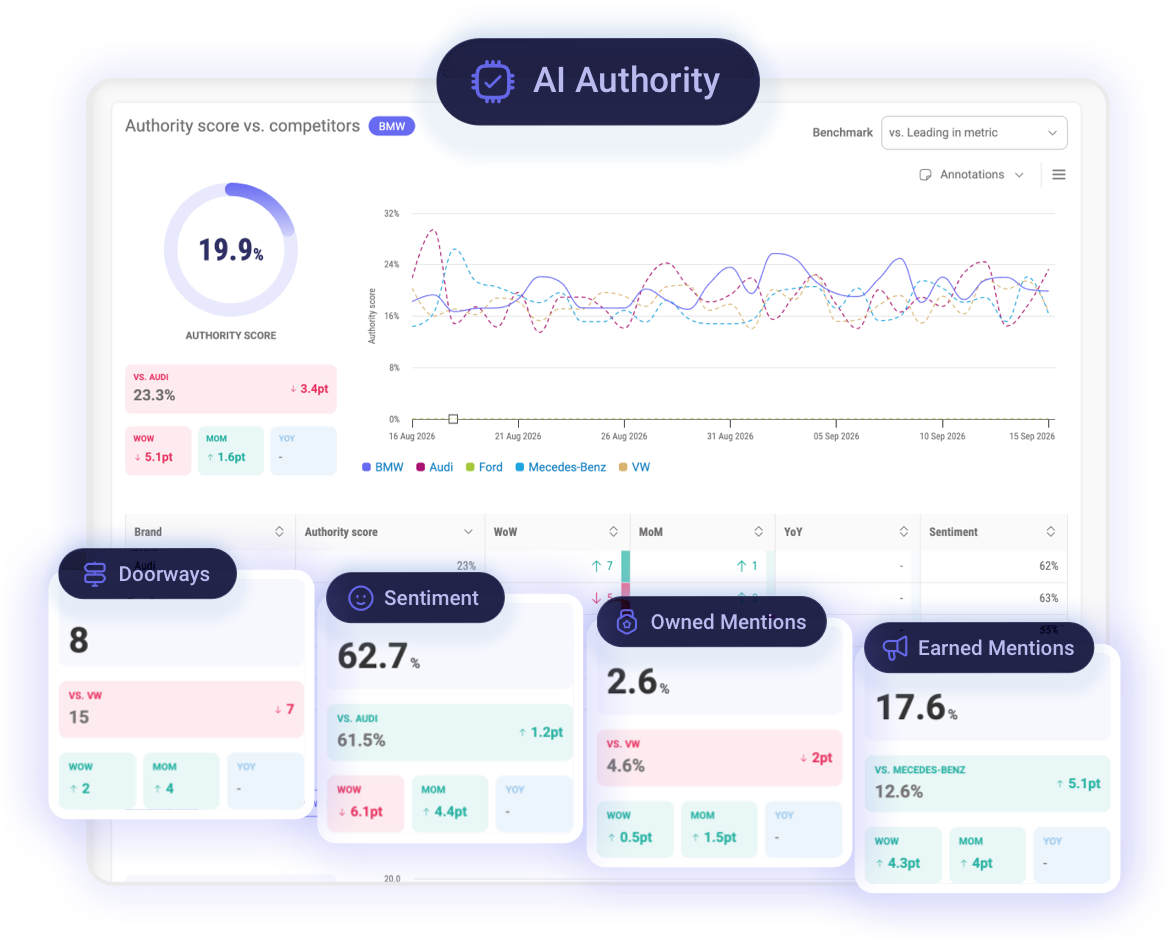
Pi’s Authority Score brings performance across connected questions and conversations into one competitive benchmark. See who is leading and move from the score into the conversations, citations and content behind your performance.
One score. Four metrics behind it.Pi’s Authority Score provides an overall benchmark for how visible and influential your brand is across the AI conversations included in your analysis.
Four component metrics reveal what is shaping the result.
Pi’s Authority Score provides an overall benchmark for how visible and influential your brand is across the AI conversations included in your analysis.
Four component metrics reveal what is shaping the result.

Doorways
How often responses provide a path to your brand's ecosystem.

Sentiment
How positively or negatively your brand is represented in responses.

Owned Mentions
Brand mentions from your owned content.

Earned Mentions
Brand mentions beyond your owned content.
Benchmark your brand against the market
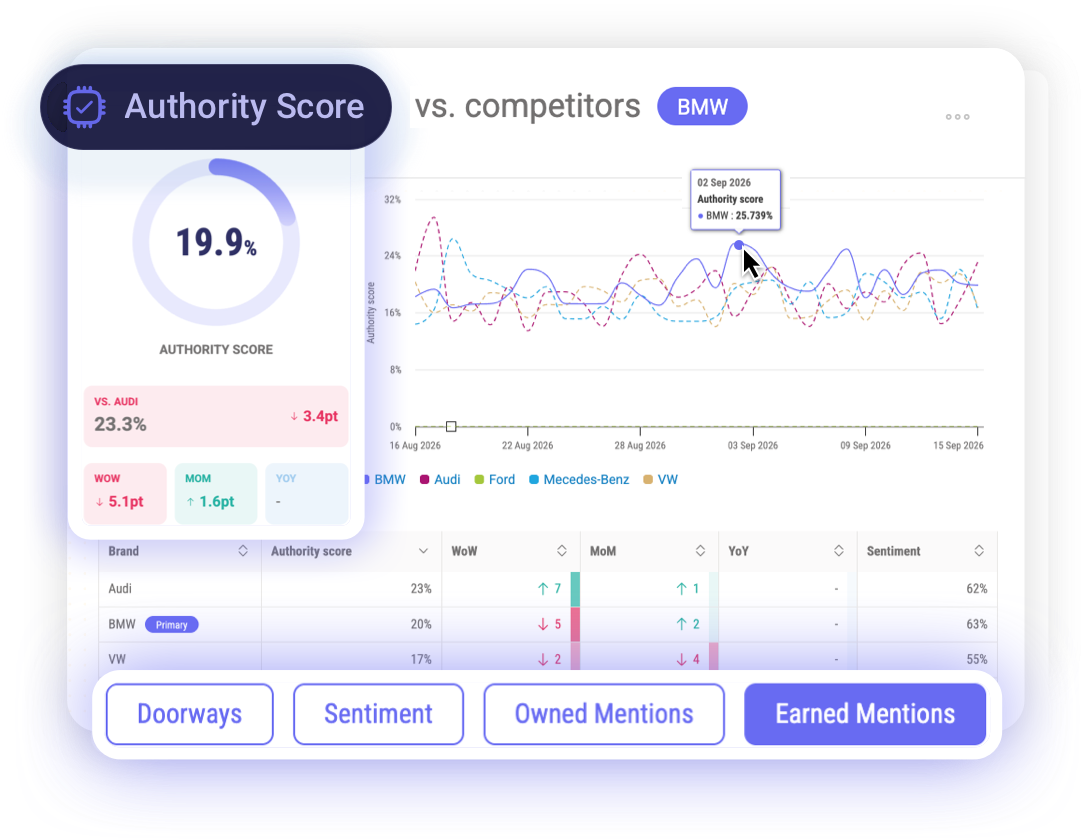
See how your Authority Score compares with the brands competing across the same conversations.
Choose the competitors that matter to your business, compare your brand with the leader or select any comparison brand for a direct benchmark.
With one consistent competitive view, you can:
- Compare Authority Scores across selected brands
- Benchmark against the leader or an individual competitor
- See where your brand leads and where it falls behind
- Move from the overall score into each component metric
- View all selected brands together
- Track week-over-week, month-over-month and year-over-year movement
- Identify emerging competitors and sustained changes in authority
Compare Doorways, Sentiment, Owned Mentions and Earned Mentions to see exactly where the competitive advantage sits and how each area of performance changes over time.
AI visibility analysis
See the content behind your score
Brand Analysis shows what is influencing your Authority Score.
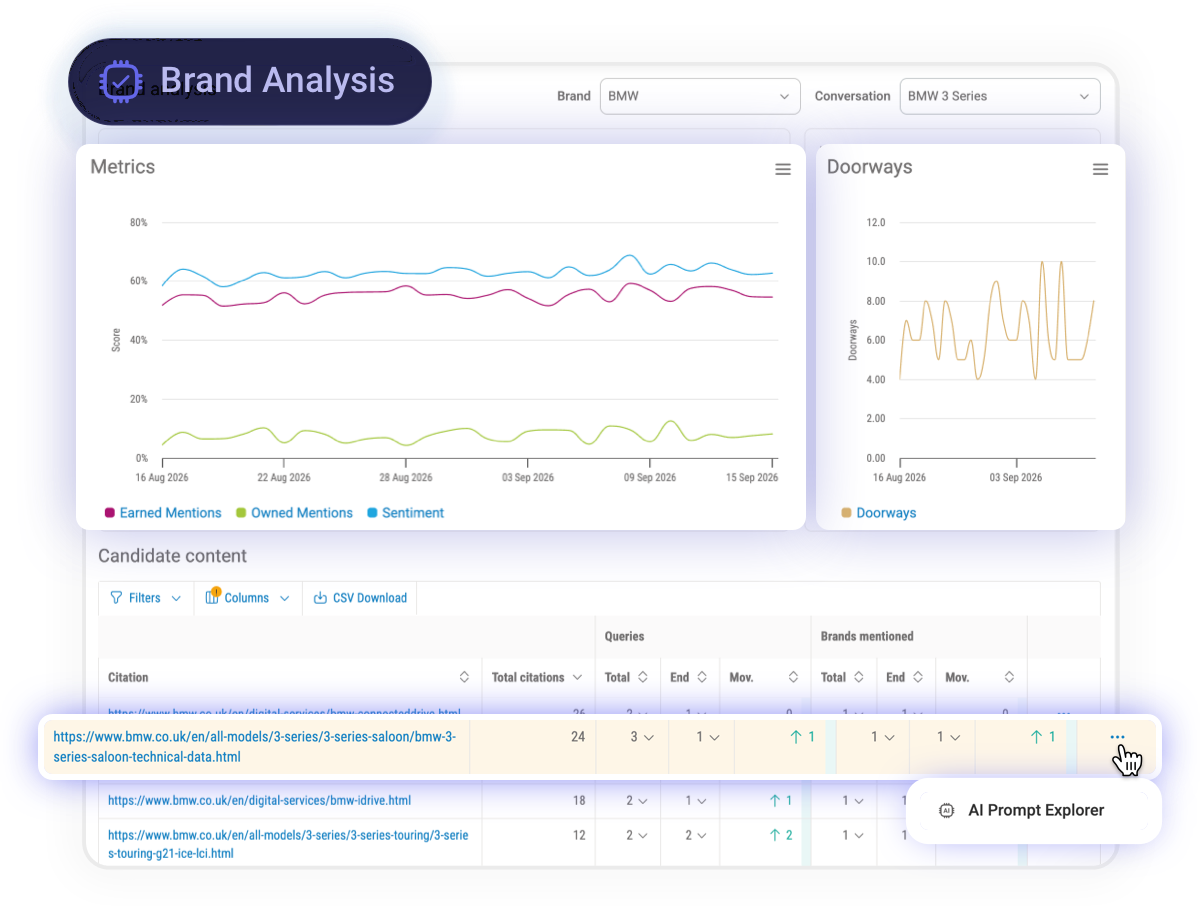
Select any brand to review performance across all conversations, or focus on one conversation to explore its component metrics, citation Doorways and Candidate Content.
Candidate Content identifies digital assets already earning citations that could become stronger candidates for AI-generated answers. See the queries and brand mentions each asset supports, track changes in citation activity and identify content that could be strengthened through greater depth, uniqueness and originality.
- Focus on any brand or conversation
- Track the four component metrics over time
- Identify the digital assets earning citations
- See the queries and brand mentions supported by each citation
- Find content gaining or losing influence
- Move into AI Prompt Explorer to investigate the supporting questions and responses
Go from knowing where your brand stands to understanding the conversations, citations and content behind its performance.
Turn AI Authority intelligence into action
Work with Pi’s experts to strengthen your authority across AI search, or connect your AI assistant directly to Pi’s search intelligence through MCP.
Explore AI Authority
AI Authority is Pi’s solution for measuring how your brand performs across AI conversations. It brings your results into a competitive view so you can see where you lead, where competitors have an advantage and what is shaping the difference.
Pi’s Authority Score is an overall benchmark for your brand’s performance across the market, answer engine and conversations included in your analysis. You can compare it with competitors and track how your position changes over time.
Unlike a basic AI visibility score, which may focus primarily on whether and how often a brand appears, authority provides a broader view of performance. It considers how consistently the brand and its wider ecosystem appear, whether mentions come from owned or third-party sources, how the brand is represented and whether responses create citation doorways to its digital assets.
Pi’s AI Authority Index combines four component signals: Asset Presence, Earned Mentions, Owned Mentions, Sentiment and Doorways.
Together, these signals create a clear benchmark for each selected view. The headline score shows your overall position, while the component signals provide the context needed to understand what is shaping the result across the conversations or topics included in your analysis.
The Authority Score brings together four component metrics: Doorways, Sentiment, Owned Mentions and Earned Mentions. You can explore each metric to understand what is contributing to your score.
Together, these signals provide a headline measure of brand visibility and influence across the conversations or topics included in the analysis.
Users can explore each component and the supporting brand, site and performance data to understand what is influencing the score.
The score is specific to the selected workspace, market, answer engine, groups and reporting period. It is therefore most useful as a competitive benchmark and a way to monitor movement over time, rather than as a universal score for a brand.
There is no universal AI authority score that represents good performance across every brand, market or answer engine.
The most useful benchmark is your position relative to relevant competitors and your own movement over time.
A strong result should reflect consistent Asset Presence, a healthy balance of Owned and Earned Mentions, positive brand representation and citation Doorways into your digital ecosystem.
Pi provides the competitive context needed to understand whether your score represents market leadership, an emerging advantage or an opportunity for improvement.
An AI visibility score checker may show whether your brand appears across a set of prompts. AI Authority lets you benchmark performance across connected conversations or selected topics, then investigate the metrics, citations and content behind the score.
Traditional search encouraged people to compress their needs into short keywords. AI search allows people to describe a complete problem and continue exploring it through follow-up questions.
An initial question can develop into a connected journey covering discovery, comparison, evaluation and recommendation. Different brands and sources may appear as that conversation progresses.
A brand that appears in the opening response may disappear later. Another may enter when the user asks for alternatives, comparisons or a final recommendation.
Measuring isolated prompts only provides snapshots of this journey. It cannot always show whether a brand remains influential throughout the complete conversation.
Pi’s conversation-first approach measures brand performance across connected, multi-turn journeys, providing a more representative benchmark for conversational AI search.
Yes. Pi supports both conversation-led and topic-led measurement.
Pi believes complete conversations provide the fullest view of AI search performance. People rarely stop after one question. They use follow-ups to explore options, compare brands and refine their decisions, so measuring isolated prompts can miss how visibility changes across the wider journey.
However, there are times when a focused view is equally valuable. You may want to benchmark performance for a priority topic, product category, market or selected set of prompts without mapping a complete conversation.
Conversational measurement
Conversation-led datasets measure how a brand appears across connected, multi-turn journeys.
This provides the fullest view of whether a brand remains visible and influential as people move through discovery, comparison and recommendation.
Topic-level measurement
Topic-led datasets measure performance across selected topics, topic groups and prompts.
This provides a focused benchmark for teams that want to report on defined areas of strategic importance without measuring a complete conversational journey.
Both approaches use the same four component signals. Each selected workspace produces its own AI Authority Index for the brands, market, answer engine and groups included.
Improving your AI Authority Index begins with identifying which component signals are limiting performance.
Identify where your brand is absent
Explore relevant conversations or topics where competitors are present but your brand is missing.
Strengthen Asset Presence
Understand whether your brand and its wider digital assets are appearing consistently across AI-generated responses.
Improve your owned content
Create or improve content that answers the questions developing throughout the conversation, not only the opening prompt.
Build earned authority
Identify the publishers, review sites, communities and other third-party sources influencing AI-generated responses in your market.
Create more citation doorways
Develop useful and distinctive digital assets that AI platforms can cite and that provide a route into your wider brand ecosystem.
Monitor brand sentiment
Investigate where your brand is represented negatively or inaccurately and identify the sources influencing that perception.
Explore Pi’s AI Brand Sentiment Tool
Measure improvement over time
Track your AI Authority Index and its four component signals to understand whether your activity is creating more consistent visibility and influence.
For additional support turning AI search intelligence into an optimization strategy, explore Pi’s AEO Services.
See who is winning the AI conversation
Pi’s AI Authority Index provides the benchmark. Our AI Search Visibility Tool helps you explore the mentions, citations, sources and sentiment behind your performance across AI-generated answers and conversational search.